
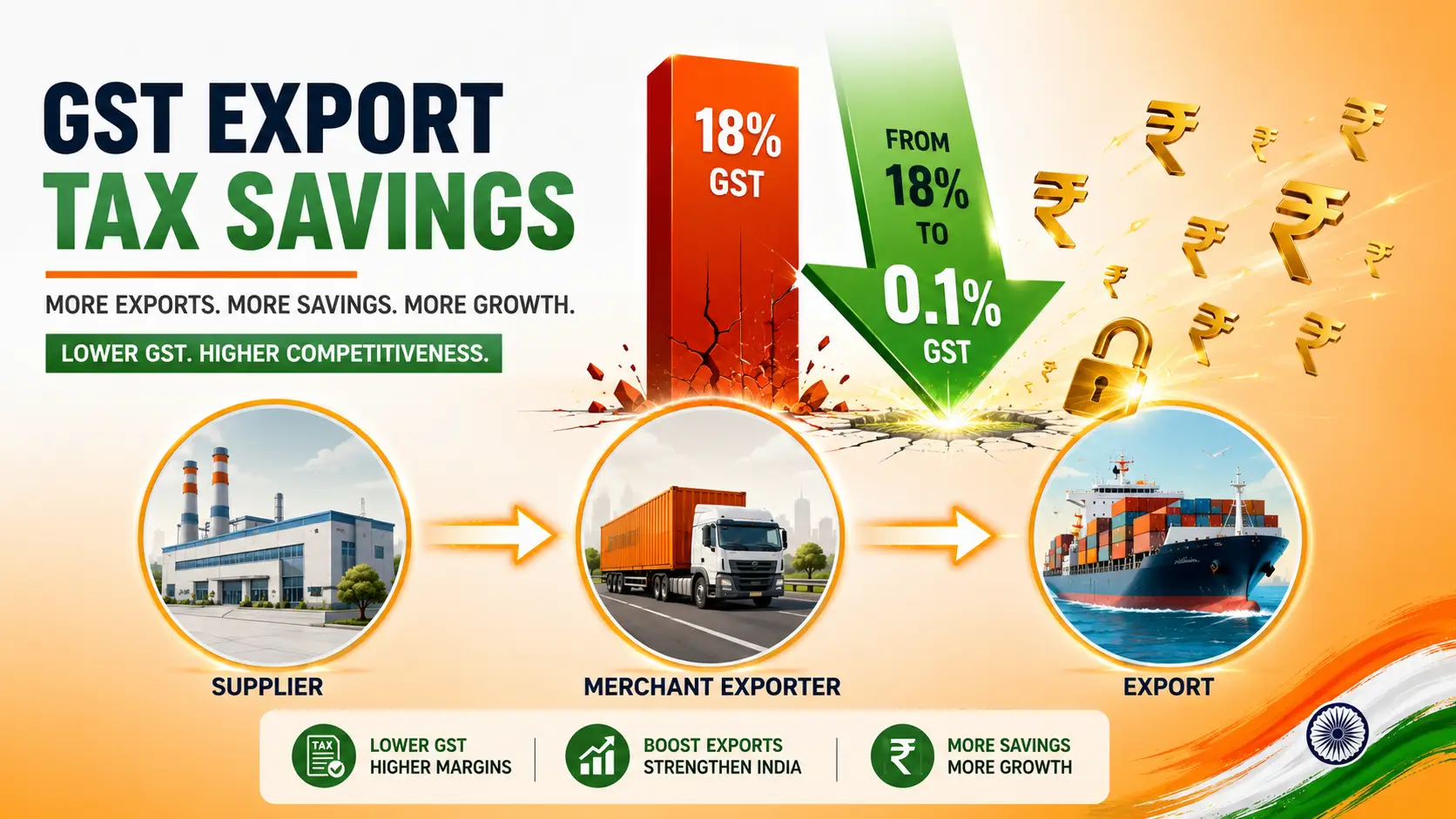
Most businesses supplying goods for export don’t know this: GST Concessional Rate for Merchant Exporters, You don’t always have to charge 5%, 12%, or 18% GST. There is a perfectly legal, government-notified mechanism that lets you supply at near-zero rates — and it has been sitting in plain sight since October 2017.
The Hidden Cash Flow Problem Draining Indian Exporters
Picture this: A textile manufacturer in Surat supplies goods worth ₹1 crore to an exporter bound for Europe. He charges 12% GST — that’s ₹12 lakhs sitting in a refund queue. The exporter eventually claims it back, but that journey takes anywhere from 3 to 9 months. Meanwhile, working capital is frozen, lines of credit strain under the weight, and growth stalls.
This is not a one-off story. Across India’s MSME and export ecosystem, businesses are collectively blocking ₹20–₹50 lakhs — sometimes crores — in GST every quarter, simply because they are unaware of a smarter, fully compliant structure: the concessional GST rate for supplies to merchant exporters.
This article breaks it all down — what it is, how it works, the exact conditions you must meet, and the costly mistakes that trip up even experienced businesses.
What Is the 0.1% GST Concessional Rate for Merchant Exporters?
Following representations from the exporter community, the GST Council, in its 22nd meeting on October 6, 2017, approved a concessional GST rate for supplies made to merchant exporters. The Central Government subsequently issued two landmark notifications:
- Notification No. 40/2017 – Central Tax (Rate) dated 23.10.2017 → Governs Intra-State supplies
- Notification No. 41/2017 – Integrated Tax (Rate) dated 23.10.2017 → Governs Inter-State supplies
Under these notifications, a registered supplier can sell goods to a registered merchant exporter at:
| Supply Type | GST Applicable |
|---|---|
| Intra-State (within same state) | CGST @ 0.05% + SGST @ 0.05% = 0.10% total |
| Inter-State (across states) | IGST @ 0.1% |
Instead of paying 5%, 12%, or 18% GST upfront and waiting months for a refund, the supplier charges a fraction of a percent — and the cash stays in the business.
🔗 Read the official notifications at CBIC India
Who Is a Merchant Exporter?
A merchant exporter is a trader who purchases goods from domestic suppliers and exports them directly — without being involved in manufacturing. Unlike a manufacturer-exporter who makes what he sells, the merchant exporter’s business model is purely trade-based procurement and export.
This distinction matters under GST. The GST concessional rate for merchant exporters notifications are specifically designed for the Supplier → Merchant Exporter → Foreign Buyer chain. Manufacturer-exporters procuring goods for their own production process are not eligible under this route.
How the Supply Chain Works
┌──────────────┐         Tax Invoice         ┌────────────────────┐         Export         ┌───────────────┐
│  Registered  │  ──── @ 0.05%/0.1% GST ──► │ Merchant Exporter  │ ──── Goods + LUT ────► │ Foreign Buyer │
│   Supplier   │                             │ (Registered + EPC) │                         │               │
└──────────────┘                             └────────────────────┘                         └───────────────┘
The beauty of this structure is that:
- The supplier charges near-zero GST, eliminating a large ITC build-up problem
- The merchant exporter exports under a Letter of Undertaking (LUT) without paying IGST, and claims refund of any ITC
- Cash flow is preserved on both sides of the transaction
The 8 Conditions You Must Satisfy — Every Single Time
This is where most businesses fall short. The GST concessional rate for merchant exporters is not automatic. It is a conditional, optional exemption scheme. Fail even one condition, and you lose the benefit entirely.
Here is the complete compliance checklist based on Notifications 40/2017 & 41/2017:
✅ Condition 1 — Both Parties Must Be GST Registered
Both the supplier and the merchant exporter (recipient) must hold valid GSTIN registrations. There is no exemption for unregistered entities under this scheme.
✅ Condition 2 — Merchant Exporter Must Be Registered with an EPC or Commodity Board
The merchant exporter must hold a valid registration with an Export Promotion Council (EPC) or a Commodity Board recognised by the Department of Commerce. This typically means holding an RCMC (Registration cum Membership Certificate).
🔗 Find your relevant EPC at India’s Export Promotion Councils – Ministry of Commerce
✅ Condition 3 — A Purchase Order Must Be Placed and Submitted
The merchant exporter must place a formal order on the registered supplier for procurement at the GST concessional rate for merchant exporters. Crucially, a copy of this order must be provided to the jurisdictional tax officer of the supplier.
✅ Condition 4 — Supply Must Be on a Tax Invoice
The supplier must issue a proper Tax Invoice showing GST concessional rate for merchant exporters at the (0.05% CGST + 0.05% SGST or 0.1% IGST). A “Bill of Supply” will not suffice. The invoice must be fully compliant with GST invoice rules.
✅ Condition 5 — Export Must Happen Within 90 Days of the Tax Invoice Date
This is the most critical deadline. The merchant exporter must complete the export within 90 days from the date of the supplier’s tax invoice. Miss this window — even by a day — and the GST concessional rate for merchant exporters benefit is forfeited, and the supplier may be required to pay differential GST.
✅ Condition 6 — Shipping Bill Must Mention Supplier’s GSTIN and Invoice Number
The shipping bill or bill of export must explicitly contain the supplier’s GSTIN and the supplier’s tax invoice number. This is the legal link between the domestic supply and the export event. Without it, the entire scheme is practically indefensible during scrutiny.
✅ Condition 7 — Goods Must Move Through the Correct Route
Goods must be dispatched either:
- Directly from the supplier’s registered premises to the port, ICD, airport, or land customs station; or
- To a registered warehouse of the merchant exporter, from where they are then forwarded to the customs point for export.
Goods cannot be routed through unregistered premises. For warehouse aggregation from multiple suppliers, the merchant exporter must endorse receipt on each tax invoice and obtain a warehouse acknowledgement.
✅ Condition 8 — Post-Export Proof Must Be Furnished
After export, the merchant exporter must provide the following documents to both the supplier and the supplier’s jurisdictional tax officer:
- Copy of the Shipping Bill or Bill of Export (containing supplier GSTIN and invoice details)
- Proof of Export General Manifest (EGM) or Export Report having been filed
🔗 For a detailed breakdown of each condition, refer to IndiaFilings — Applicability of GST for Merchant Exporters
Is This the Same as Zero-Rated Supply? (A Common Confusion)
No. Absolutely not. This is one of the most widespread misconceptions in the GST export space.
| Parameter | Zero-Rated Supply | 0.1% Concessional Rate |
|---|---|---|
| Legal Basis | Section 16, IGST Act | Notifications 40 & 41/2017 |
| Who It Applies To | Exporter directly | Supplier of goods to merchant exporter |
| GST Rate | Nil / 0% | 0.05% + 0.05% or 0.1% |
| ITC Refund | Yes, for the exporter | Possible accumulated ITC for supplier |
| LUT Required? | Yes, for the exporter | Merchant exporter exports under LUT |
| Nature | Statutory right | Conditional, optional exemption |
Zero-rated supply refers to the exporter’s own export of goods or services (or supply to SEZ). The 0.1% mechanism is about the domestic supply transaction between a registered supplier and the merchant exporter — these are two entirely different legs of the transaction.
🔗 For a clear explanation of zero-rated supply, see TaxGuru — Merchant Export Under CGST Act 2017
Is Using This Rate Mandatory or Optional?
It is optional, not mandatory.
As clarified by CBIC Circular No. 37/11/2018-GST dated 15.03.2018, a manufacturer-supplier can choose to supply goods to a merchant exporter at the normal applicable GST rate as well. In that case:
- The supplier charges full GST and remits it to the government
- The merchant exporter can export on payment of IGST and claim a refund; or export under LUT and claim refund of accumulated ITC
However, if a supplier decides to charge GST at the full rate, he cannot pocket the difference — the full amount collected must be remitted. And importantly, the supplier himself cannot claim a refund claiming incidence has not been passed on (since the customer, i.e., the merchant exporter, bore the tax).
The smart play, clearly, is to use the GST concessional rate for merchant exporters — but it must be accompanied by watertight documentation.
What Happens If You Miss the 90-Day Export Deadline?
This is the single most common compliance failure. The consequences are severe:
- Loses eligibility for the GST concessional rate for merchant exporters benefit
- The supplier may be required to pay the differential GST (i.e., the difference between the applicable rate and 0.1% charged)
- Interest and penalties may apply
- Refund claims made by the merchant exporter become indefensible
There are no standard extensions provided under the notifications. If the goods have not been exported within 90 days, businesses need to proactively engage with their jurisdictional tax officer and explore remedial options — and even then, outcomes are uncertain.
Track every invoice date. Set alerts. Treat the 90-day clock as non-negotiable.
Common Mistakes That Cost Businesses Lakhs
Based on real-world experience and compliance cases, here are the most frequent errors:
🔴 Mistake 1 — Forgetting to Mention Supplier GSTIN on the Shipping Bill
This is a paperwork issue that voids the entire legal linkage. Customs officers may not flag it at the time of export — but the GST department certainly will during audit. Always verify shipping bill details before filing.
🔴 Mistake 2 — Routing Goods Through Unregistered Premises
If goods pass through a warehouse or location not registered under GST, the movement condition is violated. Ensure all intermediate storage points are registered under the merchant exporter’s GST.
🔴 Mistake 3 — Not Submitting the Purchase Order to the Tax Officer
Many businesses skip this administrative step assuming it is optional. It is not. The notification explicitly requires a copy of the purchase order to be submitted to the jurisdictional tax officer of the supplier.
🔴 Mistake 4 — Merchant Exporter Not Holding Valid EPC Registration
If the merchant exporter’s RCMC has expired or was never obtained, the eligibility condition fails — regardless of everything else being in order.
🔴 Mistake 5 — Not Furnishing Post-Export Proof to the Supplier
Suppliers often don’t follow up on post-export documentation. But without the EGM copy and the shipping bill copy reaching the supplier (and the supplier’s tax officer), the chain of compliance is incomplete.
Real-World Impact: The Numbers Don’t Lie
Consider a mid-size MSME supplier exporting goods worth ₹2 crore per month through a merchant exporter:
| Scenario | GST Charged | Monthly Tax Outflow | Annual Tax Blocked |
|---|---|---|---|
| Full Rate (12%) | ₹24,00,000 | ₹24 lakhs | ₹2.88 crores |
| Concessional (0.1%) | ₹20,000 | ₹20,000 | ₹2.4 lakhs |
| Saving / Cash Freed | — | ~₹23.8 lakhs/month | ~₹2.85 crores/year |
Even at refund efficiency of 80%, choosing the wrong structure costs your business enormous liquidity — every single month.
What About Supplies to SEZ Units?
A common query: Can the 0.1% rate be applied to supplies to SEZ developers or units?
The notifications specifically reference “merchant exporters” — entities registered with an EPC/Commodity Board. SEZ supplies are governed separately under Section 16 of the IGST Act as zero-rated supplies. The consensus view among practitioners is that the GST concessional rate for merchant exporters under Notifications 40/41/2017 does not automatically extend to SEZ supplies, though this area continues to see litigation and interpretation-based arguments. Seek professional advice before attempting to apply this rate to SEZ supplies.
Frequently Asked Questions
Q: Can a merchant exporter purchase from a trader (non-manufacturer) at 0.1%? Yes. There is no restriction in the notifications that procurement must be from a manufacturer. A merchant exporter can source from any registered supplier — manufacturer or trader — and still avail the 0.1% rate, as confirmed in CBIC and forum interpretations.
Q: Can the supplier and merchant exporter use both routes in the same financial year? Yes. The GST concessional rate for merchant exporters is transaction-specific and optional. A supplier can use the 0.1% route for some transactions and the full rate for others — both in the same year — as long as each transaction individually meets its applicable conditions.
Q: What if only part of the quantity purchased is exported? If a portion of goods purchased under the concessional scheme is not exported within 90 days, the benefit is at risk for the unexported portion. The proof of export submitted will only cover the exported quantity. The unexported balance may trigger liability for differential GST.
Q: Is this notification applicable to service exports? No. These notifications apply specifically to goods — not services. Export of services is governed by a separate framework under GST.
Your Action Plan: Start Using the 0.1% Route Correctly
Here is a practical checklist for businesses ready to implement this structure:
- Confirm merchant exporter holds valid GSTIN + EPC/Commodity Board registration (RCMC)
- Place a formal, written purchase order mentioning the GST concessional rate for merchant exporters intent
- Submit a copy of the purchase order to the supplier’s jurisdictional tax officer
- Raise a compliant Tax Invoice at 0.05%+0.05% (intra-state) or 0.1% IGST (inter-state)
- Ensure goods move directly from registered premises to port / registered warehouse
- Track the 90-day export clock from invoice date — rigorously
- Verify that shipping bill includes supplier GSTIN and supplier invoice number before submission
- After export, share EGM proof and shipping bill copy with the supplier AND the supplier’s tax officer
- Maintain all documents — invoices, order copies, shipping bills, EGM, warehouse acknowledgements — for a minimum of 5 years
Conclusion: Smart Exporters Compete on Structure, Not Just Price
The 0.1% concessional GST mechanism under Notifications 40 and 41 of 2017 is not a loophole. It is not a grey area. It is a deliberate policy tool crafted by India’s GST Council to promote exports and ease the working capital burden on the supply chain.
The businesses that are winning in international trade today are not just competing on product quality or pricing — they are optimising the financial architecture behind every shipment. Using this GST concessional rate for merchant exporters structure correctly can free up tens of lakhs in liquidity annually for a mid-size business.
But — and this is non-negotiable — the benefit only flows to those who handle compliance without shortcuts. One missed deadline, one wrong field on a shipping bill, one unregistered warehouse — and the benefit evaporates.
Get the structure right. Get the documentation tighter. And let your cash work for your business, not sit in a refund queue for months.
Who We Are
Spice Of Indian is a trusted B2B exporter of premium Indian spices, dedicated to delivering purity, authenticity, and consistent quality to global markets. Sourced directly from leading spice regions like Kerala and Unjha, our products are carefully selected, hygienically processed, and export-ready to meet international standards. With a strong focus on reliability, transparency, and long-term partnerships, we supply high-quality spices to importers, wholesalers, and food businesses across the world.
Our Product Range Includes Conventional, Organic & IPM : Green Cardamom, Chili, Cumin, Turmeric, Coriander, Ginger, Mustard, Black & White Pepper, Garlic, Onion, Cashews and Clove.
What Sets Us Apart:
🌿 Farm-to-Table Assurance – Direct sourcing from certified farmer cooperatives ensures traceability, freshness, and authenticity.
🌍 Global Certifications – Compliance with international standards including NOP, EU Organic, USDA Organic, COS, Fairtrade, BRC, Kosher, RFA, and Naturland.
⚙️ Advanced Processing Technology – Our supplier has In-house Imtech Steam Sterilization, validated with 5-log microbial reduction (Eurofins certified) for superior safety and quality.
📦 Consistent Quality & Scalability – Built to support bulk supply, contract manufacturing, and private-label requirements with reliable consistency.
Authoritative External References
- CBIC Official Website — GST Notifications
- TaxGuru — Merchant Export Under CGST Act 2017
- TaxGuru — Selling to Merchant Exporters: Full Guide on Notification 40/2017 & 41/2017
- IndiaFilings — GST for Merchant Exporters
- TaxTMI — Concessional Rates for Merchant Exporters
- Ministry of Commerce — Export Promotion Councils
- CBIC Circular No. 37/11/2018-GST dated 15.03.2018
This article is intended for educational and informational purposes only. GST laws are subject to frequent changes and circulars. Always consult a qualified Chartered Accountant or GST practitioner before making compliance decisions for your business.