GST Concessional Rate for Merchant Exporters: Full Guide
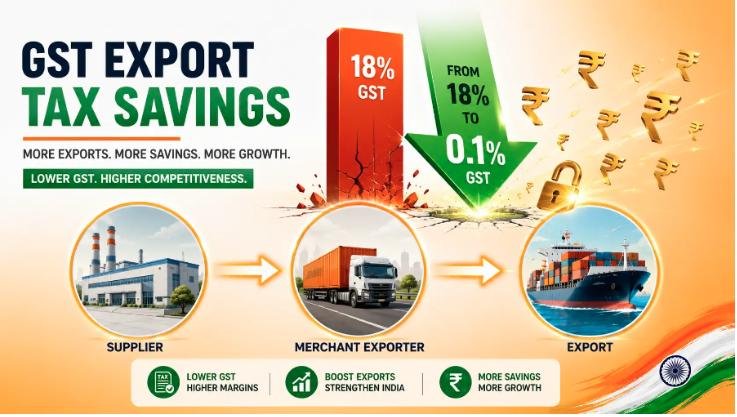
GST Concessional Rate for Merchant Exporters: Full Guide
The Hidden Cash Flow Problem Draining Indian Exporters
Domestic suppliers extending goods to export-bound merchants often remain unaware of a mechanism permitting near-zero tax rates. Across India's MSME and export ecosystem, businesses collectively block significant sums in GST quarterly due to this knowledge gap—a situation remedied through proper structuring as a "fully compliant mechanism" allowing supplies at concessional rates.
What Is the 0.1% GST Concessional Rate for Merchant Exporters?
Following exporter community representation, the GST Council approved concessional taxation in its October 2017 meeting. Two notifications govern this framework:
- Notification No. 40/2017 – Intra-State supplies
- Notification No. 41/2017 – Inter-State supplies
Applicable Rates:
| Supply Type | GST Rate |
|---|---|
| Intra-State | CGST 0.05% + SGST 0.05% = 0.10% total |
| Inter-State | IGST 0.1% |
Rather than charging standard GST percentages and awaiting refunds over months, suppliers can charge fractional rates while preserving business cash flow.
Who Is a Merchant Exporter?
A merchant exporter represents a trader purchasing domestic goods for direct export—distinguished from manufacturing-exporters who produce what they sell. This classification matters significantly under GST framework applicability.
How the Supply Chain Works
Registered Supplier → [0.05%/0.1% GST Invoice] → Merchant Exporter → [Export + LUT] → Foreign Buyer
This structure eliminates substantial Input Tax Credit (ITC) accumulation for suppliers while preserving cash flow across both transaction participants.
The 8 Conditions You Must Satisfy—Every Single Time
Eligibility requires meeting all conditions; failing even one forfeits the entire benefit.
Condition 1 – Both Parties Must Be GST Registered Both supplier and merchant exporter require valid GSTIN registrations.
Condition 2 – Merchant Exporter Must Hold EPC/Commodity Board Registration The merchant exporter must maintain valid registration with an Export Promotion Council or recognized Commodity Board (typically an RCMC—Registration cum Membership Certificate).
Condition 3 – A Purchase Order Must Be Placed and Submitted The merchant exporter must issue a formal order to the supplier, with a copy submitted to the supplier's jurisdictional tax officer.
Condition 4 – Supply Must Be on a Tax Invoice A compliant Tax Invoice showing the concessional rate must be issued (Bill of Supply is insufficient).
Condition 5 – Export Must Happen Within 90 Days of Invoice Date This represents the most critical deadline. Exceeding this window—even marginally—forfeits the benefit, potentially triggering differential GST liability for the supplier.
Condition 6 – Shipping Bill Must Mention Supplier's GSTIN and Invoice Number Export documentation must explicitly contain the supplier's identification and invoice reference, establishing the legal linkage between domestic supply and export event.
Condition 7 – Goods Must Move Through the Correct Route Goods dispatch must occur either directly from the supplier's registered premises to customs points, or through registered warehouse facilities of the merchant exporter.
Condition 8 – Post-Export Proof Must Be Furnished Following export, the merchant exporter must provide shipping bill copies and Export General Manifest proof to both the supplier and the supplier's tax officer.
Is This the Same as Zero-Rated Supply? (A Common Confusion)
No. These represent distinct mechanisms:
| Parameter | Zero-Rated Supply | 0.1% Concessional Rate |
|---|---|---|
| Legal Basis | Section 16, IGST Act | Notifications 40 & 41/2017 |
| Applies To | Exporter directly | Supplier to merchant exporter |
| GST Rate | Nil / 0% | 0.05% + 0.05% or 0.1% |
| ITC Refund | Yes, for exporter | Possible accumulated ITC for supplier |
| LUT Required | Yes, for exporter | Merchant exporter exports under LUT |
| Nature | Statutory right | Conditional, optional exemption |
Zero-rated supply concerns the exporter's own export activities; the 0.1% mechanism addresses the domestic supply transaction preceding export.
Is Using This Rate Mandatory or Optional?
It is optional, not mandatory.
Suppliers may elect to supply merchant exporters at standard applicable GST rates. However, if chosen, the full collected amount must be remitted to authorities—suppliers cannot retain the difference. Additionally, suppliers charging full rates cannot independently claim refunds based on non-passed incidence, since the merchant exporter customer bears the tax burden.
The strategic advantage clearly favors utilizing the concessional structure when compliance documentation can be maintained rigorously.
What Happens If You Miss the 90-Day Export Deadline?
Failing this deadline carries severe consequences:
- Forfeits the concessional rate benefit entirely
- May require the supplier to remit differential GST (the gap between applicable and charged rates)
- Invokes potential interest and penalty assessments
- Undermines the merchant exporter's refund claim defensibility
No standard extensions are provided. Businesses exceeding this window must engage tax authorities proactively, though remedial outcomes remain uncertain.
Treat the 90-day timeline as absolute and non-negotiable.
Common Mistakes That Cost Businesses Lakhs
Mistake 1 – Forgetting to Mention Supplier GSTIN on the Shipping Bill
This documentation failure voids the legal linkage. While customs may not flag it at export, GST audits will certainly identify it.
Mistake 2 – Routing Goods Through Unregistered Premises
Movement through unregistered warehouse or storage locations violates movement conditions. All intermediate points require GST registration under the merchant exporter's account.
Mistake 3 – Not Submitting the Purchase Order to the Tax Officer
Many businesses overlook this administrative requirement, though notifications explicitly mandate tax officer submission of purchase order copies.
Mistake 4 – Merchant Exporter Not Holding Valid EPC Registration
Expired or absent RCMC registration disqualifies the merchant exporter regardless of other compliance measures.
Mistake 5 – Not Furnishing Post-Export Proof to the Supplier
Suppliers frequently neglect follow-up on export documentation, yet this documentation gap creates compliance chain breaks that auditors will exploit.
Real-World Impact: The Numbers Don't Lie
Consider a mid-sized MSME supplier exporting ₹2 crore monthly through merchant exporters:
| Scenario | GST Charged | Monthly Tax Outflow | Annual Tax Blocked |
|---|---|---|---|
| Full Rate (12%) | ₹24,00,000 | ₹24 lakhs | ₹2.88 crores |
| Concessional (0.1%) | ₹20,000 | ₹20,000 | ₹2.4 lakhs |
| Saving/Cash Freed | — | ~₹23.8 lakhs/month | ~₹2.85 crores/year |
Even at 80% refund efficiency, suboptimal structuring drains enormous liquidity monthly.
What About Supplies to SEZ Units?
SEZ supplies fall under separate governance within Section 16 of the IGST Act as zero-rated supplies. Notifications 40/41/2017 specifically reference "merchant exporters" with EPC/Commodity Board registration. The prevailing interpretation suggests that these concessional rates do not extend automatically to SEZ supplies, though this area remains subject to ongoing litigation and interpretation disputes. Professional consultation is essential before applying this rate to SEZ transactions.
Frequently Asked Questions
Q: Can a merchant exporter purchase from a trader (non-manufacturer) at 0.1%? Yes. Notifications impose no restriction requiring procurement from manufacturers—merchant exporters may source from any registered supplier at the concessional rate.
Q: Can the supplier and merchant exporter use both routes in the same financial year? Yes. The concessional rate operates on a transaction-specific basis. A supplier may apply the 0.1% rate to some transactions and standard rates to others within the same year, provided each transaction individually satisfies its applicable conditions.
Q: What if only part of the quantity purchased is exported? If a portion remains unexported beyond 90 days, the benefit becomes at-risk for that portion. Export proof only covers quantities actually exported, potentially triggering differential GST liability on the unexported balance.
Q: Is this notification applicable to service exports? No. These notifications apply exclusively to goods. Service exports operate under separate GST frameworks.
Your Action Plan: Start Using the 0.1% Route Correctly
- Confirm merchant exporter holds valid GSTIN + EPC/Commodity Board registration (RCMC)
- Place formal, written purchase order referencing the concessional rate intention
- Submit purchase order copy to the supplier's jurisdictional tax officer
- Raise compliant Tax Invoice at 0.05%+0.05% (intra-state) or 0.1% IGST (inter-state)
- Ensure goods move directly from registered premises to port or registered warehouse
- Track the 90-day export clock from invoice date rigorously
- Verify shipping bill includes supplier GSTIN and invoice number before submission
- After export, share EGM proof and shipping bill copy with supplier and supplier's tax officer
- Maintain all documentation—invoices, order copies, shipping bills, EGM, warehouse acknowledgements—for minimum 5 years
Conclusion: Smart Exporters Compete on Structure, Not Just Price
The 0.1% concessional mechanism represents deliberate policy design by India's GST Council to promote exports and ease supply-chain working capital constraints. It is neither a loophole nor a grey area.
Leading international traders optimize financial architecture behind each shipment. Implementing this structure correctly can unlock "tens of lakhs in liquidity annually" for mid-size businesses. However, compliance demands cannot tolerate shortcuts—missed deadlines, incorrect documentation fields, or unregistered warehouse usage eliminate benefits entirely.
Perfect execution of structure and documentation permits businesses to preserve cash while maintaining full regulatory compliance.
About Spice Of Indian
Spice Of Indian operates as a trusted B2B exporter of premium Indian spices, emphasizing purity, authenticity, and consistent quality delivery to global markets. Direct sourcing from leading spice regions including Kerala and Unjha, coupled with hygienically processed export-ready products, ensures compliance with international standards.
Product Range: Conventional, Organic & IPM varieties including Green Cardamom, Chili, Cumin, Turmeric, Coriander, Ginger, Mustard, Black & White Pepper, Garlic, Onion, Cashews, and Clove.
Distinguishing Factors:
- 🌿 Farm-to-Table Assurance – Direct sourcing from certified farmer cooperatives ensures traceability and freshness
- 🌍 Global Certifications – NOP, EU Organic, USDA Organic, COS, Fairtrade, BRC, Kosher, RFA, Naturland compliance
- ⚙️ Advanced Processing Technology – In-house Imtech Steam Sterilization with 5-log microbial reduction (Eurofins certified)
- 📦 Consistent Quality & Scalability – Bulk supply, contract manufacturing, private-label support with reliable consistency
Authoritative External References
- CBIC Official Website – GST Notifications
- Ministry of Commerce – Export Promotion Councils
- CBIC Circular No. 37/11/2018-GST dated 15.03.2018
This article is educational and informational only. GST laws undergo frequent changes and circular updates. Always consult qualified Chartered Accountants or GST practitioners before implementing compliance strategies for your business.
Have a question about sourcing this from India?
Request a Quote