
Introduction
Exporters and small-to-medium businesses must pick the right shipping container to protect goods, cut costs, and avoid delays. Three specialized container types are especially useful for India’s exporters: ISO tank containers (for bulk liquids and food-grade products), ventilated containers (for organic and moisture-sensitive cargo like coffee or spices), and 40-foot high-cube containers (for extra volume). Each has unique features and capacities, so matching cargo type to container type can save money, reduce spoilage or damage, and improve logistics efficiency 1 .
In the competitive Indian export market, using the right container can make a big difference to profit margins and reliability. This guide reviews these container types in depth (with Indian context), outlines their benefits, and offers smart container-selection tips to help exporters smooth out their supply chain.
🛢️ Bulk Liquids & ISO Tank Containers (~21–26 CBM) – For transporting bulk liquids (chemicals, edible oils, beverages, etc.) in bulk shipping containers specially designed as tanks.
🔹 Ventilated Containers (20-foot, ~33 CBM) – Also called “coffee containers,” with built-in vents to keep airflow. Ideal for moisture-sensitive organic cargo like coffee beans, spices, or timber.
🔹 High Cube Containers (40-foot HC, ~76 CBM) – A standard 40ft container with an extra foot of height, giving ~10% more volume. Best for light, voluminous freight (e.g. furniture, garments, machinery).
By “smart container selection,” you minimize unused space and handling steps, protect your goods, and avoid unnecessary container rental or shipping fees. As one logistics expert notes, “the right container minimizes damage, reduces handling time, and improves fuel and space utilization—ultimately saving money” 2 . The sections below explain each container type’s design and use cases, with data-backed specs and examples, especially for India’s exporters.
ISO Tank Containers for Bulk Liquids and Food-Grade Cargo
Figure: An ISO tank container (“tanktainer”) ready to ship bulk liquids safely. ISO tanks (20-ft) hold ~21,000–26,000 L of liquid and are used for edible oils, chemicals, beverages, etc.
ISO tank containers are intermodal pressure vessels built into a 20-foot frame. They safely carry liquids in bulk – everything from edible oils, juices and wine to industrial chemicals and gases. Most standard 20ft ISO tanks hold on the order of 21,000–26,000 liters (roughly 21–26 cubic meters) of liquid.
For example, one industry guide notes that “most standard size tanks have a capacity of around 21,000 litres to 27,000 litres”3, and industry tables show typical 21,000 L and 26,000 L tanks with payloads of about 32–32.5 metric tons 4. (The total gross weight limit is often ~36 metric tons, factoring in the heavy steel tank and frame.) Newer longer ISO tanks (“swap bodies”) can carry up to ~30–35 m³ if needed, but the common 20-ft tank suffices for most exports.
ISO tanks are built to international standards (ISO norms) and have safety and cleanability features. They come in various types (T-codes): for example, T4 tanks for edible oils, T11 for general chemicals, and specially rubber-lined or food-grade tanks for acids or juices. There are also cryogenic and refrigerated tank variants for super-cold or temperature-sensitive liquids, but the bulk of general exports use the common ambient tanks. The valves and insulation meet strict regulations, and tanks are designed to be compatible with ship, rail and truck transport without needing transloading.
Why use ISO tanks? Compared to shipping liquids in barrels or drums, ISO tanks are far more efficient and cost-effective. For a given 20-ft space, a tank can carry 40% more volume than drums. This means fewer containers (and fewer container freights) are needed for the same volume. Tanks are also highly secure – double-walled with pressure relief valves – making them safer for hazardous chemicals. Moreover, tanks are reusable and durable (often 10–20 years of use), whereas drums or flexitanks (bag liners) are one-time use.
In India’s export context, ISO tanks play a key role in industries like chemicals and edible oils. India’s Gujarat and Maharashtra states have massive chemical plants (fertilizers, acids, solvents) that export globally, often filling ISO tankers bound for Europe or Southeast Asia. Likewise, India’s pulses and oilseed processing sector uses tanks for edible oils and juices.
For instance, India imports 15–16 million tonnes of edible oil yearly, but it also refines and exports specialty oils; exporters of mustard oil or groundnut oil can use ISO tanks to save on packaging (the Tamil Nadu agribusiness sector, for example). One Indian logistics guide notes ISO tank use “for chemicals from Gujarat’s industrial belt or edible oils from northern India,” highlighting exactly this trade. (For very high-volume liquid hauls, India also uses rail tank wagons and pipelines, but for containerized intermodal shipping, ISO tanks are standard.)
Key specs (20-ft ISO tank) – Length 20′ × 8′ × 8′6″, Capacity 21,000–26,000 L (approx. 21–26 m³). Gross weight ~36,000 kg; typical max cargo (payload) ≈32,000 kg. (For example, a 21,000 L tank often has payload ~32,350 kg) The payload limit means an ISO tank can often carry 30+ metric tons of cargo, enough for most chemical exports or oil shipments.
When to use – Any liquid chemical, edible oil, or beverage in bulk. If you export bulk edible products (like juice, honey, alcohol, cooking oils) or chemicals (acids, solvents, specialty chemicals), an ISO tank is ideal. It avoids handling liquids into drums; export quality stays high in the sealed tank. Many Indian chemical and food companies lease or buy ISO tanks for each sea voyage.
Considerations – ISO tanks only come in 20-ft. Loading/unloading is done via top and bottom valves. They are heavier than dry containers, and cleaning/line-cross contamination must be managed carefully (especially for food-grade). But for the right goods, they maximize transport efficiency.
Ventilated Containers for Moisture-Sensitive Exports
Figure: A 40-foot high-cube ventilated container with side vents. Built-in louvers allow air to circulate inside. This container is perfect for shipping coffee, spices, or other organic goods that need ventilation.
Ventilated containers (also called vented or coffee containers) look almost like a standard 20-foot or 40-foot box, but they have built-in vents along the top and/or bottom of the side panels. These passive air inlets keep air flowing through the cargo, helping dissipate moisture and heat buildup. They are not temperature-controlled (like a reefer) but simply allow ambient air exchange. The idea is to prevent mold, mildew or rot in goods that must “breathe” during transit.
A typical 20-foot ventilated container offers roughly the same capacity as a standard 20-ft container (~33 m³ internal volume)mobilemodularcontainers.comtoplogistics.in. (The internal dimensions are about 19′4″×7′8″×7′10″, roughly 34.9 m³ if completely filled, though usable space is ~33 m³.) Its payload is on the order of 28,000–30,000 kg 5 (maximum gross weight ~30 metric tons). Despite the added vents, a 20-ft vented container is still built to ISO standards – its structural strength and gross weight limits are similar to a dry box. There are also 40-foot ventilated containers (standard or high-cube height), with correspondingly more volume (~67–76 m³ internal) and slightly lower weight capacity (~26–28 t payload), but these are less common in practice than 20ft for ventilated cargo.
Who uses ventilated containers? The classic use is coffees and cocoas. Indeed, these are sometimes literally called “coffee containers.” Coffee beans (and cocoa beans) generate heat and moisture, so they must not be sealed tightly; ventilation prevents internal humidity and lets out volatile gases. Cardamom, pepper, and spices are also often shipped vented. In India, exporters of coffee (e.g. from Karnataka or Kerala) typically dry the beans carefully, then load them into 20-ft vented containers for shipment to Europe or the Middle East. Similarly, some tea exporters prefer vented containers if any humidity remains. The containers work like this: holes or louver vents on the container’s sides allow fresh air to continuously flush through the stacked bags. Industry sources emphasize that ventilated containers are “equipped with built-in ventilation systems to prevent dampness” and are ideal for commodities needing oxygen, like “coffee beans or spices” 6.
Beyond coffee, other organic cargo also benefits. Spices (turmeric, cinnamon, pepper), tobacco, dried fruits, nuts, and some grains (like rice or beans) can be loaded vented if they may trap moisture. Even items like fresh coconuts or bundles of sheets/planks of tea wood sometimes use vents. (Some shippers of lumber or veneer apply venting too, to avoid mildew.) The constant airflow helps keep temperatures uniform and humidity low, “preventing mold growth and condensation,” which preserves qualitypelicancontainers.com. One guide notes that ventilated containers “prolong the shelf life and reduce spoilage of fruits, vegetables, and flowers by limiting exposure to moisture”. In warehouses or on transshipments, vented boxes can even be used as temporary storage for perishable goods.
Key specs (20-ft ventilated container) – External 20′×8′×8′6″; internal ~19′4″×7′8″×7′10″. Volume ~33 m³; payload ~28,000–30,000 kgpelicancontainers.commobilemodularcontainers.com. The vents (usually slatted openings with louvers) allow airflow but keep out rain and pests.
When to use – Any shipment of humidity-sensitive cargo that is not temperature-controlled. In practice this means: green coffee beans, raw cocoa, certain spices, tobacco, even handicrafts made of organic material (bamboo mats, etc.). In India’s export trade, coffee is a prime example (India is among the world’s top coffee exporters). Spice exports from Tamil Nadu or Kerala also often use ventilated containers. Even dried fruits (mango slices, lychees) have sometimes used vents if they are not refrigerated. The “organic cargo” bullet in industry posts specifically lists coffee and cocoa 7.
Advantages – By airing out the cargo, ventilated containers maintain product integrity. They reduce the risk of moisture damage, loss of aroma or quality in coffee and spices, and keep things dry. Since the container is still ISO-standard, it plugs into normal container transport (ships, trucks, trains) without special handling or equipment. Compared to reefers, they are much cheaper (no refrigeration unit, just passive vents). And compared to standard dry boxes, they add the benefit of preventing humidity buildup.
Drawbacks – They do not protect against extreme heat or cold (no active temperature control). In very hot or monsoon climates, the temperature inside may fluctuate. Also, after use for certain goods, a container must be thoroughly cleaned, as the vents mean the cargo is exposed to outside air (dust, odors can infiltrate more easily than a sealed dry box). Finally, because of the openings, moisture is not entirely sealed out – goods that require strict moisture control (like powdered chemicals or electronics) should not use vents.
In summary, ventilated containers are a niche but vital solution: think of them as the middle ground between a dry box and a reefer. If you’re exporting things like green coffee or spices from India (say, from Coorg or Wayanad plantations), a vented container can prevent spoilage at seapelicancontainers.compelicancontainers.com. Proper stacking and air circulation are key: typically cargo is stowed to allow airflow paths, and ventilation openings are not blocked. Planning ahead with your freight forwarder to rent a vented unit can save a shipment that might otherwise mildew.
High-Cube Containers for Extra Volume (40HC)
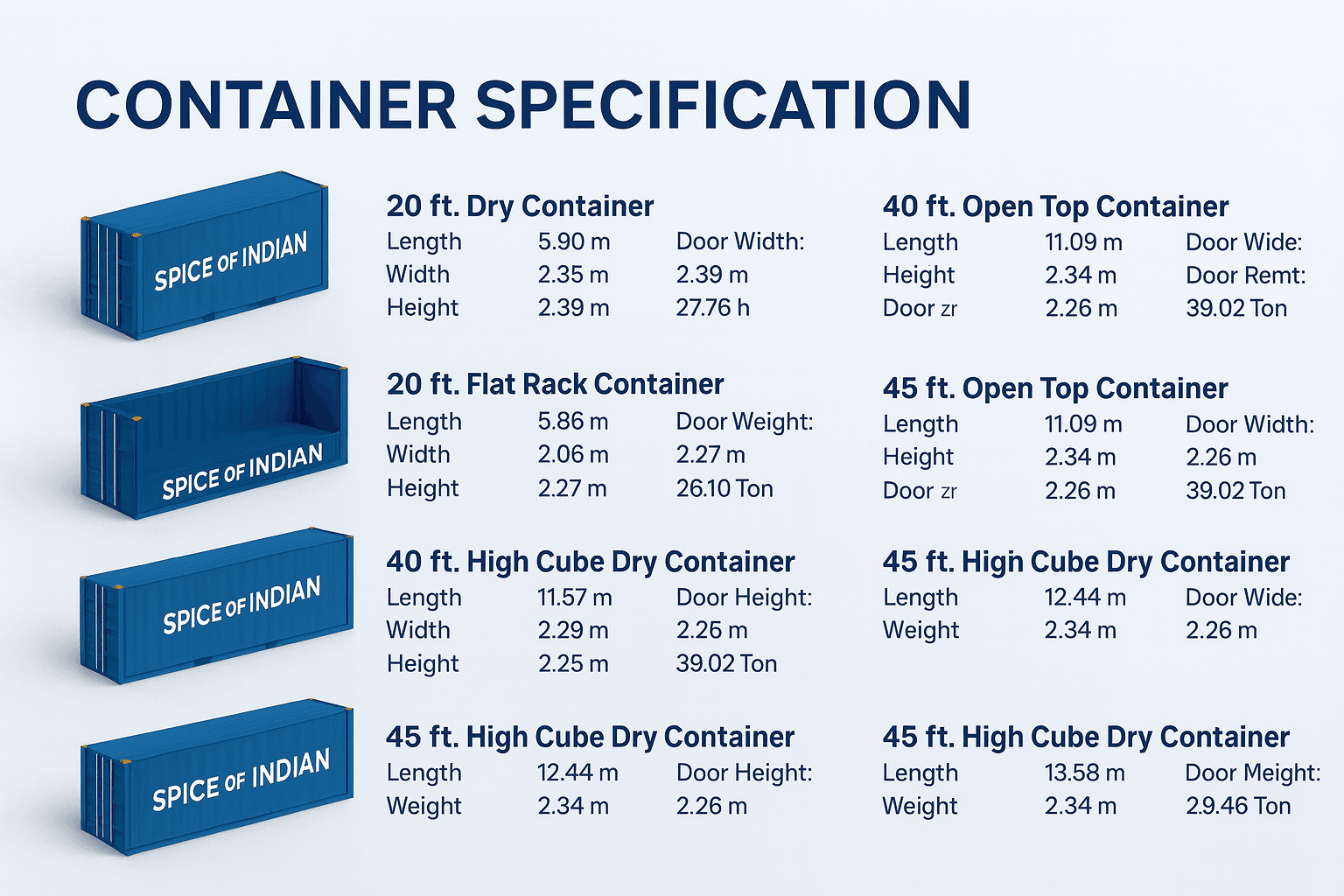
When volume (cubic space) matters more than weight, a 40-foot High Cube (40HC) container is the answer. A 40HC is identical to a standard 40′×8′ container except it is one foot taller (9′6″ high instead of 8′6″). That extra height translates to about 10% more internal volume 8. In numbers, a standard 40′ box holds ~67.7 m³, whereas a 40HC holds roughly 76.4 m³ 9. That’s an extra ~8–9 m³ – roughly the space of another half 20-foot container.
The weight limits of a 40HC are similar to a regular 40ft container. Typical specs list a max gross weight around 30,480 kg and a tare of ~4,100 kg, leaving ~26,300 kg for cargo. In practice, many shippers load 26–27 tons of cargo in a 40HC (depending on port/road limits). So you usually trade about ~1 ton of payload for 9 m³ of extra volume (versus a standard 40′). If your goods are light and bulky, this trade is worthwhile.
What to use high cubes for? High-cubes shine when you have low-density but voluminous freight. Examples include:
- Garments and textiles – Indian clothing exporters often use 40HC units because fabric bales or hanging garment racks fill lots of volume with little weight. In fact, specialized 40′ “Garment-on-Hanger” containers (GOH) are often built on HC frames to handle hanging clothes.
- Home furnishings – Furniture parts, mattresses, bulk pillows etc. furniture can take advantage of extra height for stacking.
- Consumer goods & e-commerce – E-retailers loading pallets of electronics, appliances, or toys can pack more items per container with a HC. As one source notes, “high cube containers have gained popularity in India’s growing e-commerce sector” for moving large volumes of goods 10.
- Auto parts & machinery – Tall parts or machinery can sometimes just fit in a HC that wouldn’t fit in a standard height.
- Produce and perishables (if refrigerated) – A 40HC reefer is popular for certain fruits or vegetables that need fridge and volume. (Though refrigerated 40HCs exist, most reefers are standard height.)
In India, high cubes have become more common in sectors like textiles (e.g. Tirupur garment exports) and automotive (Chennai and Pune auto parts). They are also widely used by any large exporter who already fills a standard 40′ and finds that some space remains on top or in height. The Indian government and shipping lines report that about 20–25% of new 40ft orders are HC units, reflecting their efficiency 11
Key specs (40-ft HC) – External 40′×8′×9′6″. Internal roughly 39′6″×7′9″×8′10″ (L×W×H), giving ~76.4 m³ usable volume. Max cargo typically ~26–27 tons(confirm with your carrier as road limits may vary).
When to use – If your shipment is large but light, a 40HC means fewer containers (and fewer freights) for the same volume. For example, if you need to send 70 m³ of garments, a 40HC can hold it in one container instead of two 20′s. More volume can also allow different pallet configurations (e.g. stacking 3 pallets high instead of 2). In cold chain, a 40HC reefer (if available) lets you pack slightly more fruit in the same footprint, saving trips.
Cost tradeoffs – High-cubes sometimes cost a bit more to rent or buy (a few hundred dollars more per unit), but this is often offset by the savings from needing fewer containers. Even if a 40HC freight line rate is slightly higher than standard 40′, the per-cubic-meter cost is lower because you’re shipping ~10% more volume in one go. It’s an example of the “right container, lower cost” principle. If, however, weight is your limiting factor (e.g. heavy metal goods), you may not benefit: a HC might reach its 27 t limit long before it fills up, so you might as well use standard 40′ or even two 20′ to stay under weight.
High Cube vs. Standard – Always remember that height restrictions can apply. If your truck or rail route has low bridges or the port has overhead cranes capped at 8′6″, a 40HC might not be usable. Before ordering a HC, confirm with your forwarder that it’s allowed on both origin and destination inland routes. In India, main highways and container ports (like Nhava Sheva, Mundra, Chennai, Kolkata) generally accommodate HC without issue, but always double-check.
Choosing the Right Container: Cost, Risks, and Efficiency
Packing cargo cleverly can boost profits and reliability. Using a container poorly suited to your goods leads to empty space, higher shipping charges, and even product losses. Here are some practical tips and factors to consider when picking a container for an export shipment (especially in the Indian context):
- Match container type to cargo: Identify if your cargo is liquid, dry, perishable, heavy, bulky, or fragile. If it’s a liquid, consider an ISO tank. If it needs ventilation (coffee, cocoa, wood), choose a vented container. For perishables requiring cold, use a reefer (not covered here, but crucial for fruit/vaccine exports). For standard packaged goods, a dry box is fine. For oversize (machinery, beams) use flat racks or open-top. Always think through your cargo’s handling and environmental needs.
- Check weight and volume: Calculate the total volume (CBM) and weight (kg) of your load. Use the container’s capacity chart (e.g. 33 m³ for 20-ft, 76 m³ for 40HC) to ensure all goods fit. Likewise, ensure total weight is under the container’s payload (and any road permits). Overloading a container risks fines or forced re-packing. Similarly, under-loading (say you fill only half the volume of a HC with 5 t weight) means you’ve paid for unused space. As one logistics guide warns, choosing the correct size reduces shipping costs and maximizes space utilization.
- Plan for palletization and stacking: If your cargo will be on pallets, check how many pallets fit each container type (European pallets 1.2×0.8 m or standard US pallets). For instance, a 40HC might fit 25–27 Euro pallets. Factor in whether you can stack (some goods cannot be double-stacked). The extra height of a HC lets you stack higher, which can be a game-changer for volume.
- Inspect container features: If renting or loading, verify container condition. For vented containers, check that vents are clean and functional (no bird/bug nests, no dents blocking airflow). For tanks, ensure the interior is clean (food-grade tank must be certified). For any container, ensure doors seal and locks work. A rusty or damaged container could leak water or allow infestation. It’s often worthwhile to inspect (or get a recent inspection report) before loading the goods.
- Consider FCL vs. LCL (if applicable): Full Container Load (FCL) vs. Less-than-Container Load (LCL) is more about volume vs. service cost. If you have enough cargo to fill a container (or share one with a partner), FCL is simpler and often cheaper per unit. For smaller shipments, LCL (consolidated freight) can save money. But note that with LCL you lose control over container type: the consolidator chooses the container, and you may not get specialized containers. For example, if you need a ventilated container but your LCL agent only uses reefers and dry boxes, you might not get the airflow you need. Generally for Indian SMEs, booking FCL on a partial container (sometimes called a “charter” in Asia) can allow choosing a container type specifically.
- Factor in costs of empty space: If you ship half-empty, you pay for nothing in return. Smart packing (dunnage, airbags, wooden blocks) can help maximize cargo inside a container safely. Also, consider mix-loading: can you fill leftover space with another product or partner with another exporter? Freight forwarders often facilitate combining goods to optimize a container’s volume and weight.
- Think of supply chain risks: The right container reduces damage risk. For example, using a standard dry container to ship tea or herbs (with no airflow) could lead to condensation and spoilage. Or shipping a heavy industrial batch in a HC that fills up by weight but not volume, then trying to jam more by density – accidents can happen. On the cost side, wrong container choice might trigger wasteful extra trips: e.g. if a 20′ could have sufficed but you booked 40′, you paid more for space you didn’t need. Or vice versa, if you overloaded a single 20′ and had to ship the overflow separately, you lost unit economy. Each container move involves port handling charges, customs clearances, inland haulage, etc., so fewer containers means fewer fees and less time.
- Consult with freight partners: Local knowledge is invaluable. Freight forwarders familiar with India’s ports and regulations can advise on things like maximum allowable weights on Delhi roads, or whether Kolkata’s 25‑ton rule will limit a container’s cargo. They can also suggest local leasing options (many large Indian exporters lease their own containers at ports in Mumbai, Mundra, etc.).
In short, take a data-driven approach: quantify your shipment’s dimensions and weight, then match it to container specs (internal volume, max payload). As one logistics planner summarizes, using the right container “ultimately saves money” by minimizing handling and maximizing space use. It also “reduces handling time” and potential product damage, which for exporters translates to better reliability and reputation. A smart container decision can lower freight costs per unit and cut accident or spoilage risk – two critical goals for any SME exporter.
Best Practices in the Indian Export Context
Exporters in India face unique logistical factors: crowded ports, seasonal monsoons, and diverse product types. Here are some India-specific pointers:
- Know your ports and routes. Major ports like Nhava Sheva (Mumbai), Kandla, Mundra, Chennai and Kolkata handle millions of TEUs a year 12. These are well-equipped for all container types. Inland, remember that in some hill or northeast routes, container heights or weights might be restricted. For example, double-check if a 9′6″ container can clear underpasses en route to your factory in a smaller city.
- Seasonality matters. India’s monsoon can raise humidity dramatically. For exports of foods or wood products during this season, ventilated or dry (with silica gel packs) can prevent moisture damage. Also, shipping lines sometimes add seasonal surcharges or blank sailings. Booking well in advance and fully utilizing container space can protect against sudden price hikes or capacity crunches.
- SME considerations. Small exporters often love 20-ft containers because they’re easier to fill and handle. As noted by logistics experts, 20-ft containers are “particularly popular among Indian SMEs due to their manageable size and lower shipping costs for smaller volumes”13. If you’re a small export house, 20′ might balance cost and quantity, but don’t forget that a 20HC (if available) could give you ~9 m³ more space if you have bulkier items. For example, a small textile exporter in Tiruppur might use a 20′ for a heavy machine part shipment, but switch to a 40HC to send a large batch of cotton yarn once or twice a year (the 2023 Etsy report suggests e-commerce growth is driving such moves).
- Local trade incentives. Government export initiatives may affect container choices. For example, cold chain subsidies might make reefers cheaper, whereas export promotion councils for coffee or tea might offer guidelines on containerization to maintain quality. Stay aware of any government schemes (like special freight rates for perishables) that could tip the balance.
- Documentation and inspections. Make sure your container type is noted in export documents. Customs officials rarely object to container type if the correct commodity code is used, but it’s good practice to mention (for example) “20’ VENT container” on your packing list if shipping coffee. Also, some Indian exporters do a pre-loading inspection (and take photos of loaded containers) as a checklist to prevent disputes later.
Conclusion: Selecting for Success
Choosing the right container is not just a technical detail – it’s an investment in your supply chain. The smarter your container choice, the fewer hidden costs you’ll incur. With proper planning, exporters can avoid paying freight for empty space or, worse, lose goods to avoidable damage. As we’ve seen, ISO tanks excel for bulk liquids and food-grade cargo, ventilated containers protect organic, moisture-sensitive exports, and 40ft high-cubes maximize volume for light, bulky shipments. Aligning these container types with India’s export products (chemicals and oils from Gujarat, coffee and spices from southern states, garments from Tirupur, etc. as noted above) can significantly cut per-unit shipping cost and risk.
Finally, remember to document your learnings. Keep a “container playbook” for your team: list which container you use for which cargo, key supplier contacts, and notes on filling patterns. This institutional memory speeds up future shipments. If today’s guide helped clarify your options, consider sharing it with your colleagues or logistics partners. And we’d love to know: which container type do you use most often for your exports? Share your experience or questions below, and help fellow exporters learn.
👉 If this guide was useful, hit 👍 share it with your network, or comment below on your favorite container. Logistics is a team sport – let’s keep improving!
Sources: Container specifications and usage guidelines are drawn from industry references and manufacturer data teccontainersolutions.com toplogistics.in america1logistics.com pelicancontainers.com icontainers.com toplogistics.in (including international logistics guides and India-focused logistics publications).