Kerala Green Cardamom — Varieties, Grades & Export Guide 2026
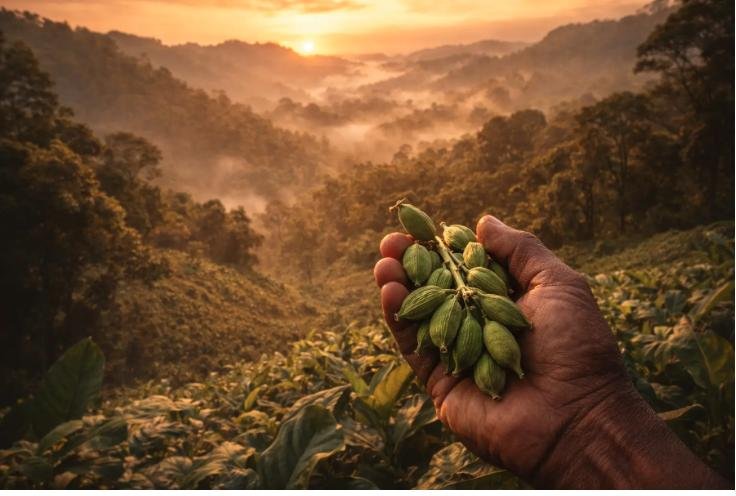
Kerala Green Cardamom — Varieties, Grades & Export Guide 2026
Introduction: The Queen Has a Homeland
Kerala green cardamom grows in the Western Ghats at 900–1,400 metres elevation, producing capsules with 4.5–9.5% essential oil content. Key aromatic compounds include α-terpinyl acetate (30–61%) and 1,8-cineole (15–49%), delivering characteristic sweet floral notes. Idukki district produces over 80% of India's cardamom. Commercial grades include Mysore (highest oil content), Vazhukka (consistent yield), and Malabar (smaller pods). Alleppey Green Cardamom holds a Geographical Indication (GI) Tag. EU-bound shipments require full compliance with Regulation (EC) 396/2005.
PART ONE: Why Kerala Green Cardamom Is the Best in the World
1. The Geography: A Perfect Accident of Nature
The Western Ghats provide ideal growing conditions:
- Temperature: Cool nights and warm days (10°C–35°C) create stress-free growing conditions
- Rainfall: Southwest and northeast monsoons provide well-distributed water supply
- Shade: Plants grow beneath natural forest canopy, slowing pod development and concentrating essential oils
- Soil: Rich laterite and forest loam soils loaded with organic matter and excellent drainage
Idukki district contains the Cardamom Hill Reserve (CHR), accounting for 80%+ of India's production. Zone A produces the highest essential oil content and most aromatic capsules. Wayanad and southern Kerala also contribute premium cardamom.
2. The Science: What Makes Kerala Cardamom Chemically Superior
Research confirms that Zone A cardamom from the Cardamom Hill Reserve in Idukki shows the highest essential oil content and strongest concentrations of 1,8-cineole and α-terpinyl acetate.
These compounds create the sensory profile:
- α-Terpinyl acetate (30–61% of oil): Responsible for sweet, floral, mildly spicy notes
- 1,8-Cineole (15–49% of oil): Adds cool, slightly camphoraceous undertone
Essential oil yield ranges from 4.5–9.5%, with oxygenated monoterpenes (40.7–66.7%), monoterpene hydrocarbons (23.1–58.6%), and sesquiterpenes (0.1–2.0%). Alleppey Green grade is particularly rich in α-terpinyl acetate, delivering herbaceous, sweet-spicy character globally recognized as the gold standard.
3. The Heritage: Alleppey Green Cardamom and the GI Tag
In the 18th century, the Travancore kingdom monopolized cardamom trade, with all produce sold through the Alleppey state depot. Today, Alleppey Green Cardamom holds a Geographical Indication (GI) Tag, legally protecting its origin status.
Commercial grades:
| Grade | Description |
|---|---|
| AGEB — Alleppey Green Extra Bold | Largest pods, premium pricing |
| AGB — Alleppey Green Bold | Bold pods, high essential oil |
| AGS — Alleppey Green Superior | Medium, excellent aroma-to-size ratio |
| AGSmall — Alleppey Green Small | Smaller pods, intense flavor per gram |
4. The Varieties: Kerala's Cardamom Diversity
Mysore variety: Oblong shape, deep green color, exceptionally high α-terpinyl acetate content. Preferred in European and Middle Eastern markets.
Malabar variety (Coorg Greens): Higher 1,8-cineole ratio, more camphoraceous aroma. Popular in soft drink and beverage industries.
Vazhukka variety: Robust, high-yielding hybrid of Mysore and Malabar. Balanced aromatic profile suitable for mechanical harvesting.
5. The Farming Tradition: Generations of Knowledge
Kerala farmers practice shade-grown cultivation beneath natural forest canopy. Hand-harvesting by skilled pickers selects only mature pods, ensuring optimal oil content. Post-harvest curing occurs at carefully controlled temperatures (40–50°C). Research shows that major aromatic compounds are significantly affected by drying temperatures, making precise temperature management critical.
6. The Health Benefits: Nature's Own Medicine Chest
Ayurvedic medicine has used Kerala cardamom for over 2,000 years. Modern research validates traditional uses:
- Digestive support: Manages heartburn, intestinal spasms, irritable bowel syndrome, and intestinal gas
- Respiratory health: High cineole content acts as natural decongestant for coughs, colds, bronchitis
- Antimicrobial properties: Demonstrates antibacterial and antiviral effects
- Anti-inflammatory effects: Useful for muscle and joint pain relief
- Oral health: Natural breath freshener combating harmful mouth bacteria
- Mental clarity: Warm, spicy aroma promotes focus and reduces stress
Cardamom ranks third among world's most valuable spices after vanilla and saffron.
7. Kerala vs. Guatemala: The Great Cardamom Debate
| Factor | Kerala (India) | Guatemala |
|---|---|---|
| Botanical Variety | Elettaria cardamomum (original species) | Elettaria cardamomum (derived from Indian stock) |
| Essential Oil Content | Up to 9.5% | Typically 5–7% |
| α-Terpinyl Acetate | Higher ratio — sweet, spicy note | Lower ratio — blander flavor |
| Colour | Vivid, deep green | Lighter green to beige |
| Harvest Method | Hand-picked, selective | Mostly mechanical |
| Certification | GI Tag (Alleppey Green) | No equivalent GI protection |
| Price | Premium | Commodity |
Kerala cardamom wins on quality for perfumery, baking, specialty coffee, and fine dining. Guatemala dominates on volume and price.
PART TWO: How to Export Kerala Green Cardamom to Europe
PHASE 1: Business Setup & Legal Foundations
Step 1: Register Your Business Entity
Options include: - Sole Proprietorship - Partnership Firm - Private Limited Company (recommended for serious exporters) - Limited Liability Partnership (LLP)
Register under the Companies Act, 2013. Obtain PAN and open a business current account.
Step 2: Obtain an Import Export Code (IEC)
The IEC is mandatory for all international trade. Apply online at DGFT portal (dgft.gov.in). Submit PAN card, bank certificate/cancelled cheque, address proof, and passport photo. Processing time: 2–5 working days. Cost: approximately ₹500.
Step 3: Register with the Spices Board of India
The Spices Board regulates all spice exports. Registration is mandatory for cardamom exporters. Apply through the Kochi office or online at spicesboard.com. Submit IEC, business registration documents, and bank details.
Step 4: Obtain an FSSAI Export License
The Food Safety and Standards Authority of India license is required for all food exporters. Register for a Central FSSAI License through the FoSCoS portal.
PHASE 2: Sourcing, Quality Control & Grading
Step 5: Source Premium Kerala Cardamom
Option A: Direct Farm Sourcing Partner directly with Idukki or Wayanad growers for maximum quality control and traceability.
Option B: Spices Board Auction Purchase at regulated auctions at Bodinayakanur (world's largest cardamom auction centre) or Kumily in Idukki.
Option C: Licensed Spice Dealers/Aggregators Work with established dealers in Kochi who aggregate and grade cardamom from multiple farms.
What to look for: - Vibrant, deep green capsules (not pale, yellow, or brownish) - Plump, uniform pods (7mm+ for Bold grade, 8mm+ for Extra Bold) - Strong, sweet fragrance - Moisture content below 12% - Essential oil content above 4ml/100g - No mould, insect infestation, or adulteration signs
Step 6: Understand European Grading Standards
European buyers expect cardamom graded against the European Spice Association (ESA) Quality Minima Document:
| Parameter | ESA Minimum Requirement |
|---|---|
| Ash content | Max 9.0% w/w |
| Acid insoluble ash | Max 2.5% w/w |
| Moisture content | Max 12% w/w |
| Volatile oil content | Min 4.0 ml/100g |
| Water activity | Max 0.65 (target) |
| Salmonella | Must be absent |
| Aflatoxin B1 | Max 5 μg/kg |
| Total Aflatoxin | Max 10 μg/kg |
European buyers also apply ASTA (American Spice Trade Association) Cleanliness Specifications setting limits on insect fragments, rodent excreta, mould, and extraneous matter.
Step 7: Pesticide Compliance — The Most Critical Issue
Pesticide-testing frequency for cardamom from India increased to 30% in July 2024. Between July 2021 and August 2024, 13 pesticide residue cases were reported in RASFF for Indian cardamom.
Critical steps: - Source only from farms following Good Agricultural Practices (GAP) - Maintain complete pesticide usage records at farm level - Test every export lot at NABL-accredited laboratory before shipping - Consider organic-certified cardamom to eliminate synthetic pesticide risk
Request pesticide usage logs from supplier farms before purchasing. Build traceability into supply chain from field to shipping container.
PHASE 3: Certifications That Open European Doors
Step 8: Consider Organic Certification
Organic cardamom commands significant price premiums in Europe and reduces pesticide-related rejection risk. Farm must be certified by an EU-approved organic certifying body operating in India (APOF, Control Union, IMO, Ecocert India). The conversion period from conventional to organic takes 3 years. As of October 2024, there are seven Fairtrade-certified cardamom producers, five in India and two in Guatemala.
Step 9: Consider Fairtrade Certification
Fairtrade certification is increasingly demanded by European retailers, particularly in Germany, Netherlands, and Scandinavia. It guarantees fair prices to farmers, safe working conditions, and community development. Minimum price: €5.53/kg plus Fairtrade premium of €0.99/kg (ex-works).
Step 10: Food Safety Management Systems
Most serious European buyers require: - HACCP: Systematic approach to food safety; required under EU food law - ISO 22000: International food safety management standard - FSSC 22000: Food Safety System Certification — most widely accepted by European retailers - BRC (British Retail Consortium) Global Standard: Required by most UK retailers - IFS (International Food Standard): Preferred by French and German retailers
Start with HACCP as foundation; work toward one of the above certifications based on target market.
PHASE 4: Packaging, Labelling & Documentation
Step 11: Packaging for European Standards
For bulk export (to importers/processors): - Multi-layer polypropylene or polyethylene woven bags - Inner moisture-proof liner bags - Standard bulk weights: 25kg, 50kg per bag - Packaging protects against moisture, light, and contamination during 3–4 week sea transit
For retail-ready or private-label export: - Hermetically sealed, nitrogen-flushed pouches - Aluminium foil laminates for maximum aroma protection - Resealable zipper pouches for consumer convenience
Label requirements for EU (bulk shipments): - Product name (e.g., "Green Cardamom Whole — Alleppey Green Bold") - Country of origin: India - Manufacturer/exporter name and address - Batch number - Date of manufacture and expiry date - Net weight - Colour grade (if 95% of product matches one colour grade) - Organic certification number and logo (if applicable) - Fairtrade logo (if applicable)
Step 12: Prepare Your Export Documentation
Every shipment to Europe requires complete documentation:
| Document | Purpose | Issued By |
|---|---|---|
| Commercial Invoice | Details buyer, seller, goods, and transaction value | Exporter |
| Packing List | Itemises weight, quantity, and dimensions | Exporter |
| Bill of Lading (BL) or Airway Bill (AWB) | Transport contract and receipt | Shipping line/airline |
| Certificate of Origin | Proves goods are of Indian origin (EU may grant GSP tariff benefits) | Chamber of Commerce |
| Phytosanitary Certificate | Confirms product is free from plant pests and diseases | Plant Quarantine Authority (India) |
| Spice Export Certificate | Issued by Spices Board of India; mandatory for all spice exports | Spices Board of India |
| FSSAI Certificate | Confirms food safety compliance | FSSAI |
| Health/Sanitary Certificate | Required by some EU member states | EIC / APEDA |
| Organic Certificate | Required if selling as organic | Certifying body |
| Lab Test Reports | Pesticide residue, mycotoxin, microbiological test results | NABL-accredited lab |
| Insurance Certificate | Covers cargo loss or damage during transit | Insurance company |
Critical tip: Never ship without complete pesticide residue test report from accredited laboratory. EU customs may test up to 30% of Indian cardamom consignments; rejection is far more costly than testing.
PHASE 5: Finding European Buyers
Step 13: Understand European Market Channels
Importers/Wholesalers: Large spice importers in Germany, Netherlands, UK, France, and Scandinavia care deeply about consistency, documentation, and compliance.
Processors and Blenders: Companies producing curry powders, spice mixes, masalas, and food ingredients often require specific grades and consistent quality across shipments.
Organic and Fairtrade Retailers: Health food stores and organic supermarkets actively seek certified organic cardamom.
Speciality/Ethnic Retailers: Serve South Asian, Middle Eastern, and food-enthusiast communities across Europe.
Online Direct-to-Consumer: Growing post-COVID channel via Amazon EU, Etsy, or branded e-commerce.
Step 14: How to Find and Approach European Buyers
B2B Platforms: - Alibaba.com — largest global B2B platform - IndiaMART and TradeIndia — connect exporters - ECTA (European Cardamom and Spice Trading Association) directories
Trade Fairs (highly recommended): - SIAL Paris — one of world's largest food industry trade shows - ANUGA, Cologne — biennial food and beverage trade fair - BioFach, Nuremberg — world's leading organic food trade fair - Fi Europe — Food Ingredients Europe
Cold Outreach: Build professional company profile and product catalogue. Send samples with full documentation (lab reports, certifications, GI tag details) to potential buyers. Use LinkedIn to connect with procurement managers at spice importers.
Spices Board Export Promotion: Register to access government-facilitated market entry support, buyer-seller meets, and exhibitions.
PHASE 6: Logistics, Shipping & Payment
Step 15: Choose Your Shipping Method
Sea Freight (Recommended for large lots): - Most economical for bulk shipments (FCL — Full Container Load, or LCL — Less than Container Load) - Transit time from Indian ports to Europe: approximately 20–28 days - Main ports: Cochin (Kochi) Port, Chennai Port, Nhava Sheva (Mumbai) - Destination ports: Rotterdam (Netherlands), Hamburg (Germany), Felixstowe (UK), Antwerp (Belgium) - Use reefer (refrigerated) containers only during extreme heat; standard dry containers typically sufficient - Ensure containers are clean, odour-free, and fumigated before loading
Air Freight (For high-value or urgent shipments): - 3–5 day transit time; significantly higher cost - Recommended for premium organic/Fairtrade lots or trial shipments - High-value spices typically advance payment required
Step 16: Work with a Freight Forwarder
Licensed Customs House Agent (CHA) and Freight Forwarder handle: - Booking cargo space with shipping lines - Export customs clearance at Indian port - Preparation and submission of shipping documents - Coordination of EU import customs clearance - Marine cargo insurance
Recommended global forwarders: Maersk, MSC, DHL Global Forwarding, Kuehne+Nagel. Also explore FIATA-licensed Indian freight forwarders based in Kochi or Chennai.
Step 17: Understand Incoterms and Payment Terms
Common Incoterms for spice exports:
| Incoterm | Meaning | Risk Transfer |
|---|---|---|
| FOB (Free on Board) | Exporter delivers goods to Indian port; buyer arranges shipping | At port of origin |
| CIF (Cost, Insurance, Freight) | Exporter pays shipping and insurance to destination port | At destination port |
| DAP (Delivered at Place) | Exporter delivers to buyer's premises | At buyer's premises |
Payment Terms: - T/T (Telegraphic Transfer): 30–50% advance, balance before shipping — standard for new relationships - Letter of Credit (LC): Bank-guaranteed payment against documents — most secure for large shipments - D/A or D/P (Documents Against Acceptance/Payment): More flexible but carries risk - For first-time buyers, always insist on at least 30–50% advance payment
Step 18: Get Export Credit Insurance
Protect against buyer default or insolvency through Export Credit Guarantee Corporation of India (ECGC) Export Credit Insurance. Particularly important when extending credit terms to European buyers.
PHASE 7: EU Customs, Tariffs & Compliance
Step 19: Know the EU Tariff and Import Rules
Green cardamom (HS Code 0908.31) generally enters the EU duty-free from India under the EU Generalised Scheme of Preferences (GSP) — provided you present valid Certificate of Origin (Form A/GSP certificate). This gives Indian exporters significant competitive advantage.
Key EU regulations: - EU Regulation 396/2005: Sets Maximum Residue Levels (MRLs) for pesticides - EC Regulation 1881/2006: Sets limits for mycotoxins and contaminants - EU Regulation 2017/625: Official controls on food and feed imports - EC Regulation 178/2002: General food law and traceability requirements
Important note: India is on the EU's enhanced monitoring list for cardamom. Up to 30% of Indian cardamom shipments are tested at EU borders. A single rejection gets logged in RASFF database and can trigger 100% inspection of all subsequent shipments from your company.
PHASE 8: Building Your European Brand
Step 20: Differentiate with Your Kerala Story
European consumers increasingly seek authenticity, origin stories, and heritage. Kerala cardamom possesses all of these:
- Lead with the GI Tag — legally certified mark of geographical authenticity
- Highlight farming region: "From the Cardamom Hills of Idukki"
- Use the "Queen of Spices" narrative
- Tell story of hand-picking, shade-growing, and traditional curing methods
- If organic, make certification central to brand identity
Step 21: Build a Digital Presence
Even for B2B exports, professional digital presence is essential: - Clean, professional website with product specifications and downloadable certifications/lab reports - LinkedIn company page and active presence in spice industry groups - Professional export catalogue in PDF (print-ready) - Apply for Spices Board export promotion grants to fund European trade fair participation
Common Mistakes to Avoid
Pesticide non-compliance: Single biggest cause of EU rejections for Indian cardamom. Never ship without full lab testing.
Inadequate documentation: Missing phytosanitary certificate or incomplete Certificate of Origin can hold shipment in customs for weeks.
Sourcing adulterated stock: European buyers routinely use DNA analysis and spectroscopy to detect adulteration. Used pods mixed with fresh cardamom or cardamom from Nepal/Bhutan presented as Indian-origin constitute food fraud, permanently destroying reputation.
Ignoring moisture content: Cardamom with moisture above 12% triggers mould, mycotoxin risk, and EU rejection. Invest in proper drying and temperature-controlled storage.
Skipping Spices Board registration: Mandatory. Shipping without it exposes you to serious legal risk.
Conclusion: Kerala's Green Gold Awaits Europe
Kerala green cardamom represents a living connection to one of the world's oldest agricultural traditions, refined by millennia of cultivation in the Western Ghats' misty highlands. Its superior essential oil content, complex aromatic profile, rich cultural heritage, and GI-protected authenticity make it genuinely the world's finest cardamom.
Europe is ready for it. Michelin-starred chefs, organic food retailers, artisanal bakers, and specialty coffee roasters across the continent actively seek premium, traceable, certified sources. The regulatory path is demanding — but for exporters investing in quality, compliance, and relationships, the rewards are substantial.
Your journey begins in the cardamom hills of Idukki. It ends on the shelves of the finest food stores in Amsterdam, Berlin, Paris, and London.
Have a question about sourcing this from India?
Request a Quote