
Introduction: The Queen Has a Homeland
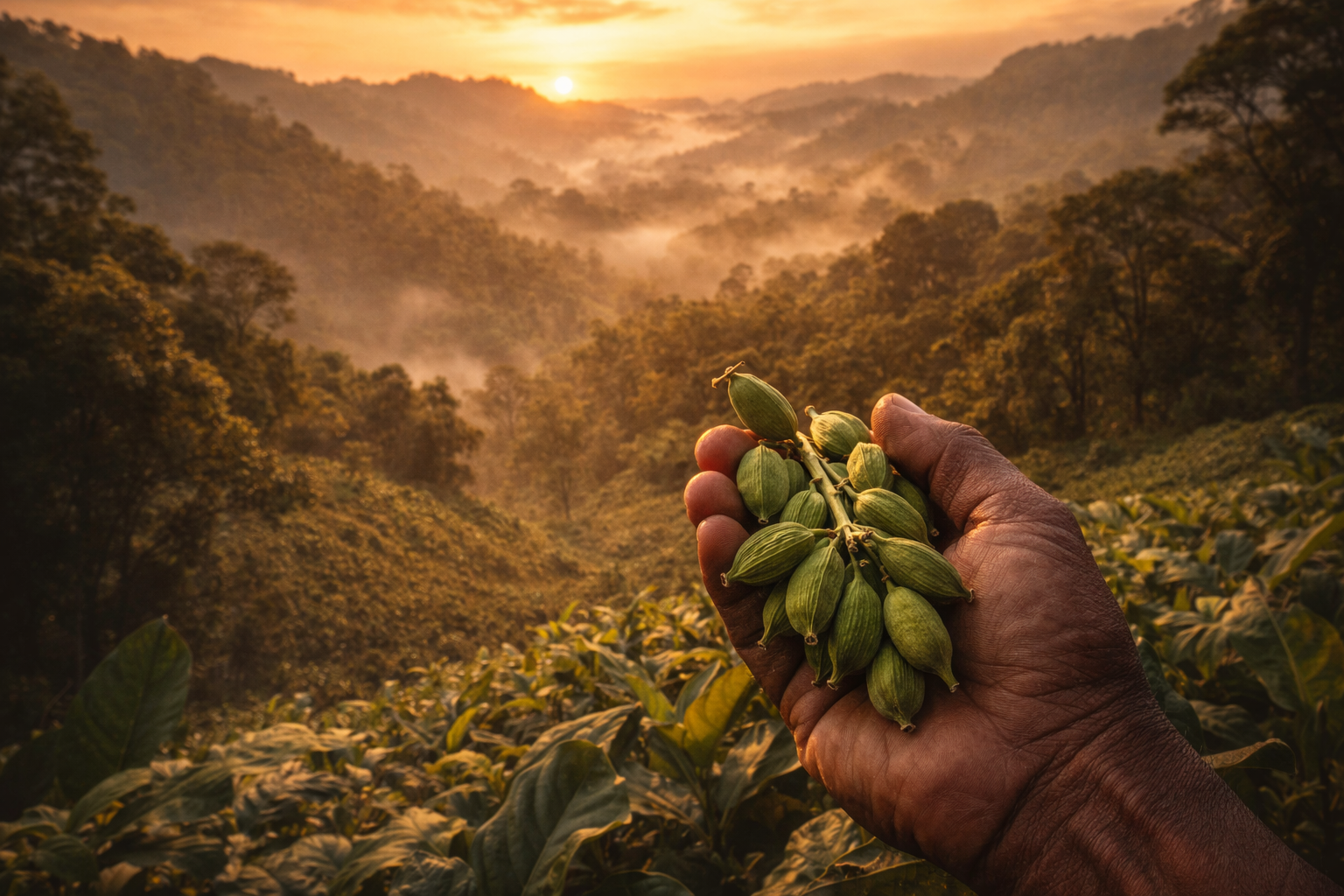
Long before the spice routes of the ancient world drew merchants across desert and sea, the misty highlands of Kerala were already coaxing something extraordinary from the earth. Kerala green cardamom — Elettaria cardamomum — has been growing wild and cultivated across the Western Ghats for millennia. Kerala green cardamom is referenced in ancient Hindu texts like the Arthashastra, Susruta Samhita, and Charaka Samhita. Greek traders were buying Kerala green cardamom in the 4th century BCE. Romans prized Kerala green cardamom. Arab merchants made fortunes on Kerala green cardamom.
Today, Kerala’s green cardamom is still considered the world’s finest — not out of nostalgia, but because the science, the soil, and the centuries of accumulated farming wisdom all confirm it. This blog explores exactly why Kerala cardamom stands apart, and then — for those ready to take the next step — provides a full step-by-step guide to exporting it to Europe.
Kerala green cardamom continues to thrive in the region and is regarded as one of the finest spices in the world. The exceptional quality of Kerala green cardamom can be attributed to the unique growing conditions and the rich agricultural heritage of the region.
PART ONE: Why Kerala Green Cardamom Is the Best in the World
1. The Geography: A Perfect Accident of Nature
Kerala’s green cardamom is no accident — but the conditions that make it exceptional come remarkably close to one. The spice thrives in the cool, humid climate of the Western Ghats, a UNESCO World Heritage Site, at elevations between 900 and 1,400 metres above sea level. The combination of factors here is nearly impossible to replicate elsewhere:
- Temperature: Cool nights and warm days (between 10°C and 35°C) create ideal stress-free growing conditions that allow the plant to produce dense, oil-rich capsules.
- Rainfall: Kerala receives rainfall from both the southwest and northeast monsoons, giving the cardamom plant a uniquely well-distributed water supply across the seasons. This is a key reason why Kerala cardamom develops superior moisture retention and deeper flavour compounds than cardamom from drier climates.
- Shade: The plants grow beneath a natural canopy of forest trees — a traditional shade-growing practice that mimics the plant’s natural habitat and dramatically slows the pod’s development, concentrating its essential oils.
- Soil: The rich, laterite and forest loam soils of Idukki and Wayanad are loaded with organic matter and excellent drainage. This mineral-rich earth directly feeds into the chemical complexity of the capsules.
The heart of Kerala green cardamom country is Idukki district, specifically the Cardamom Hill Reserve (CHR) — over 80% of India’s total Kerala green cardamom production originates here. Within Idukki, the terrain is divided into three production zones (A, B, and C), and scientific research from Kerala Agricultural University has confirmed that Zone A produces the highest essential oil content and the most aromatic Kerala green cardamom capsules.
The districts of Wayanad and parts of southern Kerala also contribute premium cardamom, with Wayanadan cardamom particularly prized by connoisseurs for its deep, complex fragrance.
2. The Science: What Makes Kerala Cardamom Chemically Superior
The quality of cardamom comes down to chemistry — specifically its essential oil content and the precise ratio of two key compounds: 1,8-cineole (eucalyptol) and α-terpinyl acetate.
Research published in the Journal of Essential Oil Bearing Plants confirms that the highest essential oil content was recorded in cardamom samples from Zone A of the Cardamom Hill Reserve in Idukki, and chemical profiling revealed the highest content of 1,8-cineole and α-terpinyl acetate in cardamom from this zone.
Why does this matter? Because these two compounds are the backbone of cardamom’s entire sensory profile:
- α-Terpinyl acetate (typically 30–61% of the oil) is responsible for the sweet, floral, mildly spicy note that makes Kerala cardamom so universally beloved. It is the compound that lingers on the palate and gives dishes that haunting aromatic finish.
- 1,8-Cineole (typically 15–49% of the oil) adds the cool, slightly camphoraceous undertone — the note that makes cardamom feel “alive” in the mouth and pairs so well with coffee and warm beverages.
The amount of essential oil yield from Indian cardamom accessions ranges from 4.5 to 9.5%, indicating substantial variation, with the main fractions being oxygenated monoterpenes (40.7–66.7%), monoterpene hydrocarbons (23.1–58.6%), and sesquiterpenes (0.1–2.0%). Kerala’s top varieties, such as Mysore and Vazhukka, consistently sit at the high end of this range — meaning more oil per capsule, more aroma, and a stronger flavour payoff per gram compared to competing origins.
The famous Alleppey Green grade — the most sought-after commercial grade of Kerala green cardamom — is particularly rich in α-terpinyl acetate, giving it a mildly herbaceous, sweet-spicy character that is globally recognised as the gold standard for Kerala green cardamom.
Kerala green cardamom is often celebrated for its remarkable flavor profile and versatility, making it a favorite among chefs and home cooks alike.
3. The Heritage: Alleppey Green Kerala Green Cardamom and the GI Tag
The story of Kerala green cardamom and Alleppey (now Alappuzha) is inseparable from trade history. In the 18th century, the Travancore kingdom held a monopoly over the trade and export of Kerala green cardamom, making all produce sold solely to the state depot at Alleppey, which was the main trading port.
Today, Alleppey Green Cardamom holds a coveted Geographical Indication (GI) Tag, legally recognising it as a product uniquely tied to its place of origin. This certification means that “Alleppey Green Cardamom” cannot be legitimately applied to cardamom from any other region — it is a quality guarantee built into international law.
The main commercial grades, recognised globally, include:
| Grade | Description |
|---|---|
| AGEB — Alleppey Green Extra Bold | Largest pods, premium pricing |
| AGB — Alleppey Green Bold | Bold pods, high essential oil |
| AGS — Alleppey Green Superior | Medium, excellent aroma-to-size ratio |
| AGSmall — Alleppey Green Small | Smaller pods, intense flavour per gram |
4. The Varieties: Kerala’s Cardamom Diversity
Today, the legacy of Kerala green cardamom continues as it holds a special place in both the culinary and medicinal traditions of India.
Kerala cultivates several distinct cardamom varieties, each with a slightly different flavour profile:
Mysore variety: Considered the finest for aroma. It has an oblong shape, a deep green colour, and exceptionally high α-terpinyl acetate content — the compound responsible for the sweet, spicy character preferred in European and Middle Eastern markets.
Malabar variety (Coorg Greens): More camphoraceous in aroma due to a higher 1,8-cineole ratio. Particularly popular in soft drink and beverage industries.
Vazhukka variety: A robust, high-yielding type developed by crossing Mysore and Malabar strains, offering a balanced aromatic profile and sturdy capsules suited for mechanical harvesting.
5. The Farming Tradition: Generations of Knowledge
What separates Kerala cardamom from industrial cardamom farming elsewhere is its agricultural philosophy. Kerala farmers, many of them third- and fourth-generation growers, practice shade-grown cultivation. The cardamom plants live beneath the forest canopy — not under plastic netting, but under real trees that create a microclimate of filtered sunlight, regulated humidity, and natural mulch.
Harvesting is done entirely by hand, which matters enormously. Cardamom pods do not ripen uniformly — skilled pickers select only the mature pods, returning to the same plant multiple times over a season. This selective hand-picking ensures optimal oil content and prevents the immature or over-ripe pods that degrade quality in mechanically harvested lots.
Post-harvest, the pods are cured at carefully controlled temperatures (typically 40–50°C). Research has shown that the major compounds responsible for the specific aroma of cardamom — 1,8-cineole and α-terpinyl acetate — are significantly affected by drying temperatures, making precise temperature management during curing critical to preserving the final flavour profile.
6. The Health Benefits: Nature’s Own Medicine Chest
Kerala’s cardamom has been used in Ayurvedic medicine for over 2,000 years. Modern science continues to validate what traditional practitioners knew centuries ago. The essential oil compounds found in abundance in Kerala cardamom have demonstrated:
- Digestive support: Cardamom helps manage heartburn, intestinal spasms, irritable bowel syndrome, and intestinal gas — functions attributed to its 1,8-cineole and α-terpineol content.
- Respiratory health: The high cineole content makes cardamom oil an effective natural decongestant, helpful against coughs, colds, and bronchitis.
- Antimicrobial properties: Cardamom oil exhibits antibacterial and antiviral effects.
- Anti-inflammatory effects: Useful in muscle and joint pain relief when used in massage.
- Oral health: A natural breath freshener that combats harmful bacteria in the mouth — which is precisely why cardamom pods are traditionally chewed after meals across South Asia.
- Mental clarity: The warm, spicy aroma promotes focus and reduces stress — making it a beloved ingredient in aromatherapy.
The third most valuable spice in the world after vanilla and saffron, cardamom earns its title of “Queen of Spices” not just through flavour, but through a remarkably comprehensive portfolio of wellness benefits.
7. Kerala vs. Guatemala: The Great Cardamom Debate
Guatemala is the world’s largest cardamom producer by volume, accounting for the majority of global supply. So why does Kerala cardamom command a premium price in Europe and beyond?
The differences come down to variety, growing altitude, oil composition, and taste profile:
| Factor | Kerala (India) | Guatemala |
|---|---|---|
| Botanical Variety | Elettaria cardamomum (original species) | Elettaria cardamomum (derived from Indian stock) |
| Essential Oil Content | Up to 9.5% | Typically 5–7% |
| α-Terpinyl Acetate | Higher ratio — sweet, spicy note | Lower ratio — blander flavour |
| Colour | Vivid, deep green | Lighter green to beige |
| Harvest Method | Hand-picked, selective | Mostly mechanical |
| Certification | GI Tag (Alleppey Green) | No equivalent GI protection |
| Price | Premium | Commodity |
For perfumery, high-end baking, speciality coffee, and Michelin-starred kitchens — the preference is clear. Kerala cardamom wins on quality. Guatemala wins on volume and price. The European market increasingly understands and pays for this distinction.
PART TWO: How to Export Kerala Green Cardamom to Europe — A Step-by-Step Guide
The European market presents enormous opportunity for Kerala cardamom. From German curry powder giants to British private-label chains, Italian artisanal blenders, and French Michelin-starred kitchens, they all want Indian cardamom — but only if it is perfectly clean, fully traceable, and 100% compliant. Here is the complete roadmap.
PHASE 1: Business Setup & Legal Foundations
Step 1: Register Your Business Entity
Before you can export a single gram of cardamom, you need a formally registered business. In India, your options include:
- Sole Proprietorship — simplest structure for small operations
- Partnership Firm — for two or more persons
- Private Limited Company — recommended for serious exporters; offers limited liability and better credibility with European buyers
- Limited Liability Partnership (LLP) — a popular middle ground
Register your business under the Companies Act, 2013 (for companies) or the relevant state regulation for proprietorships. Obtain a PAN (Permanent Account Number) and open a current bank account in the business name.
Step 2: Obtain an Import Export Code (IEC)
The IEC (Import Export Code) is the single most essential document for any Indian exporter. It is issued by the Directorate General of Foreign Trade (DGFT) and is mandatory for all international trade.
How to obtain it:
- Apply online at the DGFT portal: dgft.gov.in
- Submit PAN card, bank certificate/cancelled cheque, address proof, and passport-size photo
- Processing time: typically 2–5 working days
- Cost: ₹500 (approximately)
Step 3: Register with the Spices Board of India
The Spices Board of India, under the Ministry of Commerce and Industry, regulates all spice exports from India. Registration is mandatory for cardamom exporters.
The Spices Board:
- Issues the Spice Export Certificate
- Enforces quality standards for exported cardamom
- Operates the Cardamom Auction Platform at Bodinayakanur and Kumily
- Provides market intelligence and buyer connections for exporters
Apply through the Spices Board office in Kochi or online at spicesboard.com. You will need your IEC, business registration documents, and bank details.
Step 4: Obtain an FSSAI Export License
The Food Safety and Standards Authority of India (FSSAI) license is required for all food product exporters. This certifies that your production and handling processes comply with Indian food safety regulations, which is also a prerequisite for EU market entry.
Register for a Central FSSAI License (mandatory for exporters) through the FoSCoS portal.
PHASE 2: Sourcing, Quality Control & Grading
Step 5: Source Premium Kerala Cardamom
Where and how you source your cardamom determines everything that follows. Your options:
Option A: Direct Farm Sourcing Partner directly with cardamom growers in Idukki, Wayanad, or the Cardamom Hills. This gives you maximum control over quality and traceability — both of which European buyers increasingly demand. Many farms in Idukki welcome direct buyer partnerships and can arrange farm visits.
Option B: Spices Board Auction The Spices Board operates regulated cardamom auctions at Bodinayakanur (the world’s largest cardamom auction centre) and Kumily in Idukki. Buying through auction gives you access to graded, certified lots with transparent pricing linked to real market rates.
Option C: Licensed Spice Dealers/Aggregators Work with established spice dealers in Cochin (Kochi) — one of India’s major spice trading hubs — who aggregate and grade cardamom from multiple farms.
What to look for when sourcing:
- Vibrant, deep green capsules (not pale, yellow, or brownish)
- Plump, uniform pods (7mm+ for Bold grade, 8mm+ for Extra Bold)
- Strong, sweet fragrance even before crushing
- Moisture content below 12% (ESA requirement)
- Essential oil content above 4ml/100g (ESA minimum)
- No signs of mould, insect infestation, or adulteration
Step 6: Understand European Grading Standards
European buyers expect cardamom graded against the European Spice Association (ESA) Quality Minima Document. The key parameters for cardamom are:
| Parameter | ESA Minimum Requirement |
|---|---|
| Ash content | Max 9.0% w/w |
| Acid insoluble ash | Max 2.5% w/w |
| Moisture content | Max 12% w/w |
| Volatile oil content | Min 4.0 ml/100g |
| Water activity | Max 0.65 (target) |
| Salmonella | Must be absent |
| Aflatoxin B1 | Max 5 μg/kg |
| Total Aflatoxin | Max 10 μg/kg |
Additionally, European buyers commonly apply ASTA (American Spice Trade Association) Cleanliness Specifications, which set limits on insect fragments, rodent excreta, mould, and extraneous matter.
Step 7: Pesticide Compliance — The Most Critical Issue
This is where many Indian cardamom exporters run into difficulty. The pesticide-testing frequency for nutmeg, mace and cardamom from India increased to 30% in July 2024, making India one of the most scrutinised origins at EU borders. Between July 2021 and August 2024, 13 pesticide residue cases were reported in RASFF for cardamom, mostly concerning cardamom from India.
What this means for you:
- Source only from farms that follow Good Agricultural Practices (GAP) and use only approved pesticides in permitted quantities
- Maintain a complete record of pesticides used at farm level
- Test every export lot at an NABL-accredited laboratory before shipping
- Consider sourcing organic-certified cardamom, which eliminates synthetic pesticide risk entirely
Tip: Request and review the pesticide usage log from your supplier farms before purchasing. Build traceability into your supply chain from field to shipping container.
PHASE 3: Certifications That Open European Doors
Step 8: Consider Organic Certification
Organic cardamom commands a significant price premium in Europe and dramatically reduces the risk of pesticide-related rejections. To export organic cardamom to the EU:
- Farm must be certified by an EU-approved organic certifying body operating in India (e.g., APOF, Control Union, IMO, Ecocert India)
- Certification covers the entire process: farm inputs, post-harvest handling, processing, and packaging
- The conversion period (transition from conventional to organic farming) takes 3 years
- For organic cardamom from India and Sri Lanka, Fairtrade pricing offers a minimum price of €5.53/kg plus a Fairtrade premium of €0.99/kg (ex-works)
Step 9: Consider Fairtrade Certification
Fairtrade certification is increasingly demanded by European retailers and consumer brands, particularly in Germany, the Netherlands, and Scandinavia. It guarantees fair prices to farmers, safe working conditions, and community development investments. As at October 2024, there are seven Fairtrade-certified cardamom producers, five of which are in India and two in Guatemala.
Step 10: Food Safety Management Systems
Most serious European buyers will require one or more of the following:
- HACCP (Hazard Analysis Critical Control Point): A systematic approach to food safety that is also required under EU food law for food businesses.
- ISO 22000: International food safety management standard.
- FSSC 22000: Food Safety System Certification — the most widely accepted by European retailers.
- BRC (British Retail Consortium) Global Standard: Required by most UK retailers; increasingly accepted across Europe.
- IFS (International Food Standard): Preferred by French and German retailers.
Start with HACCP as your foundation and work toward one of the above certifications based on your target market.
PHASE 4: Packaging, Labelling & Documentation
Step 11: Packaging for European Standards
How you package your cardamom directly affects aroma retention, shelf life, and European buyer confidence.
For bulk export (to importers/processors):
- Multi-layer polypropylene or polyethylene woven bags
- Inner moisture-proof liner bags
- Standard bulk weights: 25kg, 50kg per bag
- Packaging must protect against moisture, light, and contamination during 3–4 week sea transit
For retail-ready or private-label export:
- Hermetically sealed, nitrogen-flushed pouches
- Aluminium foil laminates for maximum aroma protection
- Resealable zipper pouches for consumer convenience
Label requirements for EU (bulk shipments): Your label must include:
- Product name (e.g., “Green Cardamom Whole — Alleppey Green Bold”)
- Country of origin: India
- Manufacturer/exporter name and address
- Batch number
- Date of manufacture and expiry date
- Net weight
- Colour grade (if 95% of product matches one colour grade)
- Organic certification number and logo (if applicable)
- Fairtrade logo (if applicable)
Step 12: Prepare Your Export Documentation
Every shipment to Europe requires a complete set of documents. Missing even one can result in customs delays, fines, or rejection of the entire consignment. You will need:
| Document | Purpose | Issued By |
|---|---|---|
| Commercial Invoice | Details buyer, seller, goods, and transaction value | Exporter |
| Packing List | Itemises weight, quantity, and dimensions | Exporter |
| Bill of Lading (BL) or Airway Bill (AWB) | Transport contract and receipt | Shipping line/airline |
| Certificate of Origin | Proves goods are of Indian origin (EU may grant GSP tariff benefits) | Chamber of Commerce |
| Phytosanitary Certificate | Confirms product is free from plant pests and diseases | Plant Quarantine Authority (India) |
| Spice Export Certificate | Issued by Spices Board of India; mandatory for all spice exports | Spices Board of India |
| FSSAI Certificate | Confirms food safety compliance | FSSAI |
| Health/Sanitary Certificate | Required by some EU member states | EIC / APEDA |
| Organic Certificate | Required if selling as organic | Certifying body |
| Lab Test Reports | Pesticide residue, mycotoxin, microbiological test results | NABL-accredited lab |
| Insurance Certificate | Covers cargo loss or damage during transit | Insurance company |
Tip: Never ship without a complete pesticide residue test report from an accredited laboratory. EU customs may test up to 30% of Indian cardamom consignments, and a rejection is far more costly than the test itself.
PHASE 5: Finding European Buyers
Step 13: Understand European Market Channels
Accessing the European market requires compliance with strict regulations on contamination, pesticide residues, heavy metals and additives. Supply chain transparency is also increasingly important, due to rising concerns about food fraud.
The European cardamom import landscape is structured through several distinct channels:
Importers/Wholesalers: Large spice importers in Germany, Netherlands, UK, France, and Scandinavia buy bulk lots and distribute to processors, food manufacturers, and retailers. These buyers care deeply about consistency, documentation, and compliance.
Processors and Blenders: Companies that produce curry powders, spice mixes, masalas, and food ingredients. They often require specific grades and will work with exporters who can guarantee consistent quality across multiple shipments.
Organic and Fairtrade Retailers: High-growth segment. Health food stores, organic supermarkets (e.g., Naturkost in Germany, Planet Organic in UK) actively seek certified organic cardamom.
Speciality/Ethnic Retailers: Serve South Asian, Middle Eastern, and food-enthusiast communities across Europe. Often smaller orders but loyal repeat business.
Online Direct-to-Consumer: A growing channel, especially post-COVID. Selling directly via Amazon EU, Etsy, or your own branded e-commerce store.
Step 14: How to Find and Approach European Buyers
B2B Platforms:
- Alibaba.com — largest global B2B platform
- IndiaMART and TradeIndia — connect with Indian exporters‘ communities
- ECTA (European Cardamom and Spice Trading Association) directories
Trade Fairs (highly recommended):
- SIAL Paris — one of the world’s largest food industry trade shows
- ANUGA, Cologne — biennial food and beverage trade fair
- BioFach, Nuremberg — world’s leading organic food trade fair (perfect for organic cardamom)
- Fi Europe — Food Ingredients Europe
Cold Outreach:
- Build a professional company profile and product catalogue
- Send samples with full documentation to potential buyers (lab reports, certifications, GI tag details)
- Use LinkedIn to connect with procurement managers at spice importers
Spices Board Export Promotion: The Spices Board of India regularly organises buyer-seller meets, exhibitions, and export development programmes. Register with them to access government-facilitated market entry support.
PHASE 6: Logistics, Shipping & Payment
Step 15: Choose Your Shipping Method
Sea Freight (Recommended for large lots):
- Most economical for bulk shipments (FCL — Full Container Load, or LCL — Less than Container Load)
- Transit time from Indian ports to Europe: approximately 20–28 days
- Main ports: Cochin (Kochi) Port, Chennai Port, Nhava Sheva (Mumbai)
- Destination ports: Rotterdam (Netherlands), Hamburg (Germany), Felixstowe (UK), Antwerp (Belgium)
- Use reefer (refrigerated) containers only if shipping during extreme heat; standard dry containers are typically sufficient for dried whole cardamom
- Ensure containers are clean, odour-free, and fumigated before loading
Air Freight (For high-value or urgent shipments):
- 3–5 day transit time; significantly higher cost
- Recommended for premium organic/Fairtrade lots or trial shipments to new buyers
- High-value spices such as cardamom are typically sent by plane, and buyers often make full or partial payments in advance.
Step 16: Work with a Freight Forwarder
Do not attempt to manage international shipping logistics alone. A licensed Customs House Agent (CHA) and Freight Forwarder will handle:
- Booking cargo space with shipping lines
- Export customs clearance at the Indian port
- Preparation and submission of shipping documents
- Coordination of EU import customs clearance (with the buyer’s customs broker)
- Marine cargo insurance
Recommended global freight forwarders: Maersk, MSC, DHL Global Forwarding, Kuehne+Nagel. Also explore FIATA-licensed Indian freight forwarders based in Kochi or Chennai.
Step 17: Understand Incoterms and Payment Terms
Common Incoterms for spice exports:
| Incoterm | Meaning | Risk Transfer |
|---|---|---|
| FOB (Free on Board) | Exporter delivers goods to Indian port; buyer arranges shipping | At port of origin |
| CIF (Cost, Insurance, Freight) | Exporter pays shipping and insurance to destination port | At destination port |
| DAP (Delivered at Place) | Exporter delivers to buyer’s premises | At buyer’s premises |
Payment Terms:
- T/T (Telegraphic Transfer): 30–50% advance, balance before shipping — standard for new relationships
- Letter of Credit (LC): Bank-guaranteed payment against documents — most secure for large shipments
- D/A or D/P (Documents Against Acceptance/Payment): More flexible but carries risk
- For first-time buyers, always insist on at least 30–50% advance payment
Step 18: Get Export Credit Insurance
Protect yourself against buyer default or insolvency by taking Export Credit Insurance through the Export Credit Guarantee Corporation of India (ECGC). This is particularly important when extending credit terms to European buyers.
PHASE 7: EU Customs, Tariffs & Compliance
Step 19: Know the EU Tariff and Import Rules
The good news: green cardamom (HS Code 0908.31) generally enters the EU duty-free from India under the EU Generalised Scheme of Preferences (GSP) — provided you present a valid Certificate of Origin (Form A/GSP certificate). This gives Indian exporters a significant competitive advantage.
Key EU regulations to be aware of:
- EU Regulation 396/2005: Sets Maximum Residue Levels (MRLs) for pesticides
- EC Regulation 1881/2006: Sets limits for mycotoxins and contaminants
- EU Regulation 2017/625: Official controls on food and feed imports
- EC Regulation 178/2002: General food law and traceability requirements
Note: India is on the EU’s enhanced monitoring list for cardamom. This means up to 30% of Indian cardamom shipments are tested at EU borders. A single rejection gets logged in the RASFF database and can trigger 100% inspection of all subsequent shipments from your company.
PHASE 8: Building Your European Brand
Step 20: Differentiate with Your Kerala Story
European consumers are increasingly seeking authenticity, origin stories, and heritage. Kerala cardamom has all of this in abundance:
- Lead with the GI Tag — it is a legally certified mark of geographical authenticity
- Highlight your farming region: “From the Cardamom Hills of Idukki” carries genuine resonance
- Use the “Queen of Spices” narrative
- Tell the story of hand-picking, shade-growing, and traditional curing methods
- If organic, make the certification central to your brand identity
Step 21: Build a Digital Presence
Even for B2B exports, a professional digital presence is now essential:
- A clean, professional website with product specifications, certifications, and lab reports available for download
- A LinkedIn company page and active presence in spice industry groups
- An export catalogue in PDF (professional, print-ready)
- Consider applying for Spices Board’s export promotion grants, which can fund participation in European trade fairs
Key Export Costs to Budget For
Conclusion: Kerala Green Cardamom’s Green Gold Awaits Europe
Common Mistakes to Avoid
Pesticide non-compliance. This is the single biggest cause of EU rejections for Indian cardamom. Never ship without full lab testing.
Inadequate documentation. A missing phytosanitary certificate or incomplete Certificate of Origin can hold your shipment in customs for weeks.
Sourcing adulterated stock. European buyers now routinely use DNA analysis and spectroscopy to detect adulteration. Used pods mixed with fresh cardamom, or cardamom from Nepal/Bhutan presented as Indian-origin, constitute food fraud and will permanently destroy your reputation.
Ignoring moisture content. Cardamom with moisture above 12% will trigger mould, mycotoxin risk, and EU rejection. Invest in proper drying and temperature-controlled storage.
Skipping Spices Board registration. This is mandatory. Shipping without it exposes you to serious legal risk.
Conclusion: Kerala’s Green Gold Awaits Europe
Kerala green cardamom is not just a spice. It is a living connection to one of the world’s oldest and most storied agricultural traditions, refined by millennia of cultivation in the misty highlands of the Western Ghats. Its superior essential oil content, complex aromatic profile, rich cultural heritage, and GI-protected authenticity make it genuinely the world’s finest Kerala green cardamom.
Europe is ready for it. Michelin-starred chefs, organic food retailers, artisanal bakers, and specialty coffee roasters across the continent are actively seeking premium, traceable, certified sources of the real thing. The regulatory path is demanding — but for exporters willing to invest in quality, compliance, and relationships, the rewards are substantial.
Your journey begins in the cardamom hills of Idukki. It ends on the shelves of the finest food stores in Amsterdam, Berlin, Paris, and London.
Sources: Centre for the Promotion of Imports from Developing Countries (CBI), Spices Board of India, Journal of Essential Oil Bearing Plants, Frontiers in Sustainable Food Systems, DGFT, FSSAI, European Spice Association Quality Minima Document, RASFF EU Database, EU Access2Markets, Kerala green cardamom growers.
As the journey of Kerala green cardamom begins in the cardamom hills of Idukki, it ends on the shelves of the finest food stores in Amsterdam, Berlin, Paris, and London.