
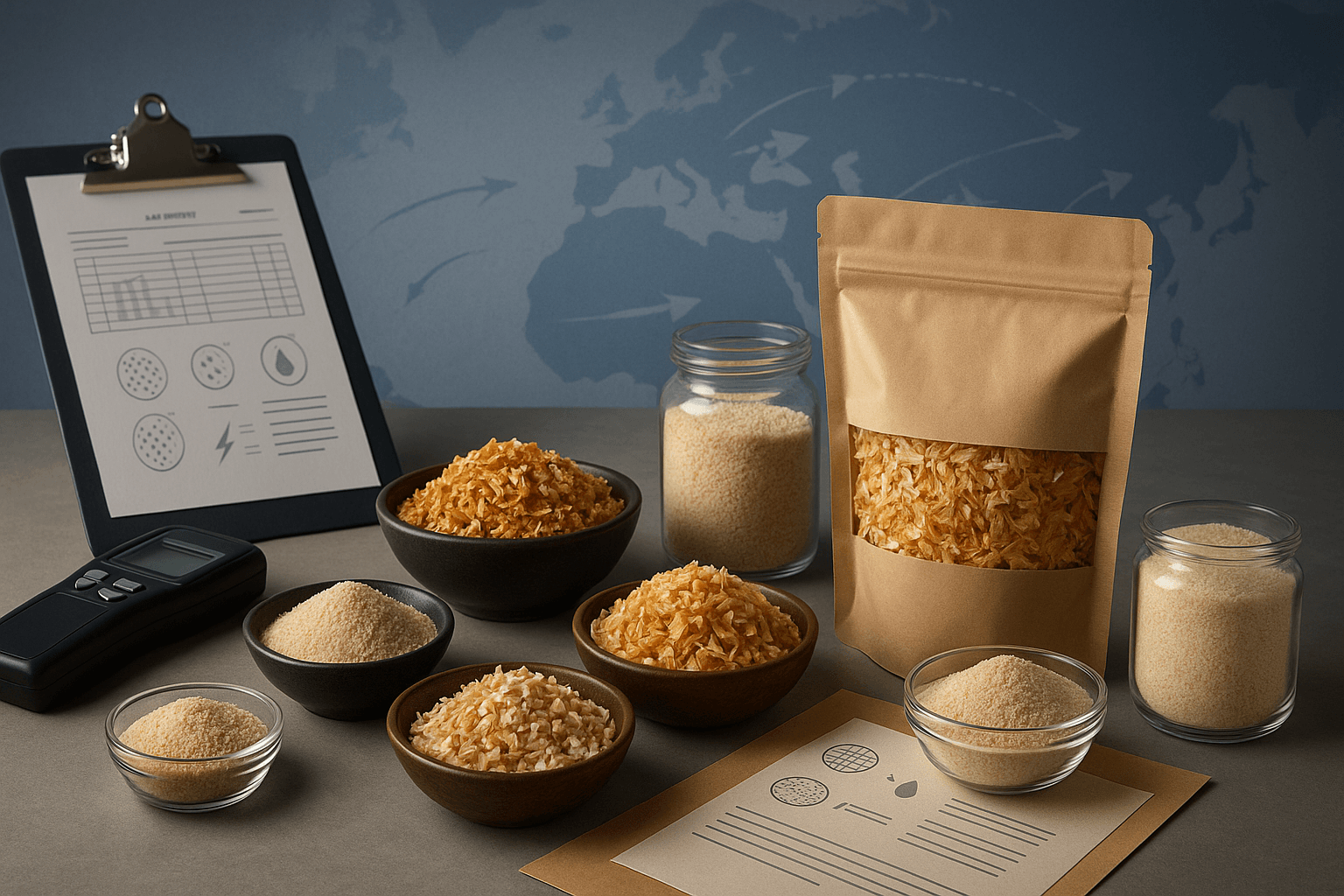
A deep-researched industry guide for international procurement teams, food manufacturers, and global importers
1. Introduction
Across the global food supply chain, few ingredients are as universally used—and universally depended upon—as dehydrated onion and dehydrated garlic. Found in everything from snacks and sauces to meat products, ready meals, seasonings, and instant mixes, dehydrated onion and garlic serve as foundational flavoring agents for thousands of FMCG and industrial food products.
As global food manufacturing scales, demand for consistent, shelf-stable, residue-compliant, cost-effective dehydrated onion and garlic has grown exponentially. Historically, buyers sourced from countries such as China, Egypt, and the United States. But in the past decade, a clear shift has occurred: the world is increasingly turning to India as the preferred supplier.
Why this shift? The answer lies in India’s massive processing capacity, stringent quality standards, competitive pricing, and unmatched supply reliability. India—especially regions like Gujarat—has emerged as the world leader in dehydration production, supported by advanced technology, year-round availability, strict quality control, and a robust export ecosystem.
For buyers seeking a supplier that can deliver volume, consistency, compliance, and competitiveness, India is now the top choice.
This detailed guide explores why global buyers are shifting to India for dehydrated onion and garlic—and how brands like Spice of Indian ensure world-class quality, specifications, and reliability.
2. Overview of the Indian Dehydrated Onion & Garlic Industry
India is one of the largest producers of onion and garlic globally—and a global powerhouse in dehydration processing.
Key Production Hubs
1. Gujarat (Mahuva, Bhavnagar, Talaja, Gondal)
Often called the Dehydrated Onion Capital of the World, Mahuva and its surrounding districts account for more than 70–75% of India’s total dehydration output.
Why Gujarat leads:
- Dry climatic conditions
- Large-scale onion and garlic farming
- Proximity to ports (Pipavav, Mundra)
- Specialized processing clusters
- Skilled labor for dehydration operations
2. Rajasthan, Madhya Pradesh & Maharashtra
These regions contribute significantly to garlic dehydration, particularly for garlic flakes, powder, and minced forms.
Processing Capacity
India’s dehydration sector is supported by hundreds of advanced plants, many with international certifications such as FSSC 22000, ISO, HACCP, and BRC.
Estimated yearly capacity:
- 1.2–1.5 million MT of fresh onion processed into dehydrated forms
- Hundreds of thousands of tonnes of dehydrated garlic processed yearly
- Advanced plants can process 80–150 MT/day of fresh produce
India now fulfills large-volume requirements from buyers across:
- Europe
- USA & Canada
- Middle East & GCC
- Japan & Korea
- Latin America
- Africa
With strong scalability, India is now preferred for long-term contracts, private label manufacturing, and industrial ingredient supply.
Common Product Range from India
Dehydrated Onion
- Kibbled (10–25mm)
- Flakes
- Chopped
- Minced
- Granules (26–40 mesh)
- Powder (60–100 mesh)
Dehydrated Garlic
- Flakes
- Chopped
- Minced
- Granules
- Powder
Specialty Variants
- Toasted onion
- Toasted garlic
- Roasted garlic powder
- Garlic TBC (Toasted Bread Crumb blends – export variant)
India also specializes in blending, custom mesh sizes, and tailor-made bulk orders for industrial applications.
3. Quality Parameters Buyers Must Know
High-quality dehydrated onion and garlic are defined by a combination of moisture, color, mesh size, aroma, pungency, microbial limits, and residue compliance.
Below are the grading standards followed by top Indian exporters, including Spice of Indian.
3a. Moisture Levels
Moisture is the most critical factor in dehydration quality.
Ideal Moisture Levels:
- Dehydrated Onion: 3–5%
- Dehydrated Garlic: 4–6%
Why low moisture matters:
- Controls mold and fungal growth
- Ensures long shelf life (18–24 months)
- Prevents spoilage during long sea freight
- Improves grindability and extraction
- Complies with EU & US standards
India’s dry climate—especially in Gujarat—helps naturally maintain low moisture levels during drying.
3b. Mesh Sizes / Granulation
Mesh size determines texture, usage, and industrial suitability.
Standard Mesh Sizes
| Product Form | Mesh Size | Use Case |
|---|---|---|
| Kibbled | 8–25 mm | Soups, flakes, instant foods |
| Chopped | 8–16 mesh | Sauces, ready mixes |
| Minced | 16–26 mesh | Meat processing, snacks |
| Granules | 26–40 mesh | Seasonings, savory snacks |
| Powder | 60–100 mesh | Spice blends, FMCG, pharma |
Customization is a major reason manufacturers prefer India.
3c. Color Grades
Color determines:
- Freshness
- Drying method
- Sulfur content
- Ingredient appeal
Onion Color Grades
- White Premium – Highest grade
- Light Yellow – Standard
- Normal Yellow – Bulk/industrial
- Toasted – For unique roasted flavor
Garlic Color Grades
- Natural white (premium)
- Light creamy (standard)
- Toasted (brownish, roasted flavor)
Indian exporters can produce consistent color batches thanks to controlled dehydration temperatures.
3d. Residue & Microbial Standards
For global buyers, compliance is non-negotiable.
Pesticide & MRL Compliance
- India follows EU’s stringent MRL (Maximum Residue Limits)
- Regular testing for organophosphates, pyrethroids, carbamates
Aflatoxin Levels
- Must be negligible (<5 ppb)
- High-quality Indian suppliers meet EU aflatoxin limits
Microbial Limits
- Total Plate Count
- Yeast & Mold
- Salmonella (Absent)
Heavy Metals
Compliant with EU/US permissible limits for:
- Lead
- Arsenic
- Cadmium
Spice of Indian supplies lab-tested batches with COA + MRL reports.
3e. Aroma, Pungency & Volatile Oils
These chemical markers define flavor strength.
Onion Parameters
- Dehydrated onion pungency
- Sulfur compound retention
Garlic Parameters
- Allicin content
- Volatile oil content
- Pungency (6,000–10,000 SHU depending on grade)
India’s superior soil profile enhances natural pungency—making Indian garlic and onion more flavorful than many global competitors.
4. Why the World Is Shifting to India: Key Advantages
Over the last decade, India has overtaken China and Egypt in many key markets. Here’s why:
4a. Massive Processing Capacity
India operates some of the world’s largest dehydration plants.
Advantages:
- Capable of meeting large industrial orders (100–300 MT/month)
- Fully automated cleaning, slicing, drying & grading
- Ability to deliver consistent bulk batches
- Multiple suppliers ensure uninterrupted continuity
Companies prefer India because supply is scalable, reliable, and stable year-round.
4b. Pricing Advantage
India provides a 15–30% cost advantage over global suppliers due to:
- Lower processing costs
- Skilled labor availability
- Large raw material base
- Efficient energy usage in dryer systems
- High-volume economies of scale
Pricing remains stable even in high-demand seasons, making India ideal for long-term procurement.
4c. Superior Quality & Traceability
Quality systems used by top Indian exporters include:
- HACCP
- FSSC 22000 / ISO Certifications
- MRL testing
- Steam sterilization
- Batch traceability from farm → factory → final packing
Spice of Indian ensures each batch meets EU, US FDA, and Gulf food safety norms.
4d. Reliability & Year-Round Availability
India leads in:
- Onion cultivation volume
- Garlic output
- Cold storage capacity
- Solar-assisted dehydration infrastructure
- Container availability & port network
As a result, buyers enjoy:
- Timely shipments
- Consistent quality
- Predictable supply chain
4e. Customization for Buyers
India offers unmatched flexibility:
- Custom mesh sizes
- Specialty powders (roasted, toasted)
- Color sorting
- Oil-enhanced pungency options
- Customized private-label packaging
- Palletization as per country regulations
This customization capability is one of India’s strongest competitive advantages.
5. Product Forms & Global Applications
Onion Flakes & Kibbled
Applications:
- Instant meals
- Dehydrated mixes
- QSR ingredients
- Noodle seasoning
Onion Granules & Minced
Used in:
- Meat processing
- Sauces
- Savory snacks
- Ready-to-eat meals
Onion Powder
Used in:
- Spice blends
- FMCG seasonings
- FMCG manufacturing
- Health supplements
Garlic Flakes, Granules, Minced
Used by:
- Meat industry
- Pickle manufacturers
- Sauces & pastes
- Condiment manufacturers
Garlic Powder
Universal use in:
- Seasonings
- Snack flavors
- Bakery
- Broths & bouillon cubes
India’s product versatility allows it to cater to multiple industries across continents.
6. Pricing Logic Explained
Indian dehydrated onion & garlic pricing depends on:
1. Raw Material Crop Size
Large crop → lower prices
Smaller crop → higher prices
2. Climate & Drying Conditions
Indian dry climate reduces energy cost → competitive pricing.
3. Mesh Size & Processing
- Finer mesh = higher processing cost
- Flakes/minced are cheaper due to less grinding
4. Color & Pungency
Premium white onion flakes cost more than yellow grades.
5. Global Freight & Logistics
Ocean freight impacts landed cost significantly.
6. Exchange Rate (USD-INR)
Stronger INR → slightly higher export pricing.
Overall, India remains competitively priced compared to China, Egypt, and US-origin products, with more stable quality.
7. Export Documentation & Quality Assurance
A reputable exporter will always provide complete documentation.
Quality Documents
- COA (Moisture, microbial, ash, volatile oil)
- Pesticide residue test (MRL)
- Aflatoxin test
- Mesh size & particle analysis
- Allergen declaration
- Non-GMO declaration
Export Documents
- Phytosanitary certificate
- Fumigation certificate
- Certificate of Origin
- Packing list
- Commercial invoice
- MSDS (if required)
Compliance Certifications
- FSSAI
- ISO / HACCP
- Organic (if applicable)
Spice of Indian follows a strict quality protocol ensuring every shipment is fully compliant and traceable.
8. Why Buyers Trust Spice of Indian
As a premium exporter of Indian spices, herbs, and dehydrated products, Spice of Indian ensures excellence in every stage:
✔ Direct Partnerships with Gujarat Dehydration Units
Long-term relationships with top processing plants ensure:
- Better pricing
- Priority scheduling
- Custom production
✔ Strict Raw Material Selection
Only sorted, mature, high-sulfur onion & garlic are chosen for dehydration.
✔ Advanced Cleaning & Sorting
- Multi-stage washing
- Stainless steel slicing
- Air drying / heated dehydration
- Metal detection
- Color sorting
✔ Laboratory Testing
Every batch is tested for:
- Moisture
- Mesh size
- Microbial limits
- MRL pesticide residue
- Aflatoxin
- Color uniformity
✔ Export-Ready Packaging
Options include:
- 20/25kg poly-lined bags
- Food-grade cartons
- Palletized loads
- Vacuum packs
✔ Global Supply Capability
Serving importers across:
- USA
- Europe
- Middle East
- Japan
- Africa
- South America
✔ Custom Specifications
Buyers can request:
- Custom mesh
- Blends
- Toasted/onion-garlic combinations
- Private-label packing
9. Conclusion & Call to Action
India has rapidly become the world’s most reliable, high-capacity, and cost-effective producer of dehydrated onion and garlic. With superior processing infrastructure, competitive pricing, strict residue compliance, and year-round supply availability, India stands far ahead of many global competitors.
For food manufacturers, spice brands, wholesalers, and industrial ingredient buyers, sourcing from India provides:
- Consistency
- Value
- Quality
- Reliability
- Compliance
- Cost efficiency
At Spice of Indian, we combine top-grade sourcing, strong supply chain partnerships, strict lab testing, and export professionalism to deliver the finest dehydrated onion and garlic products worldwide.
📩 For detailed specifications, samples, or bulk quotations—contact Spice of Indian today.
Your reliable partner for premium Indian dehydrated ingredients.