
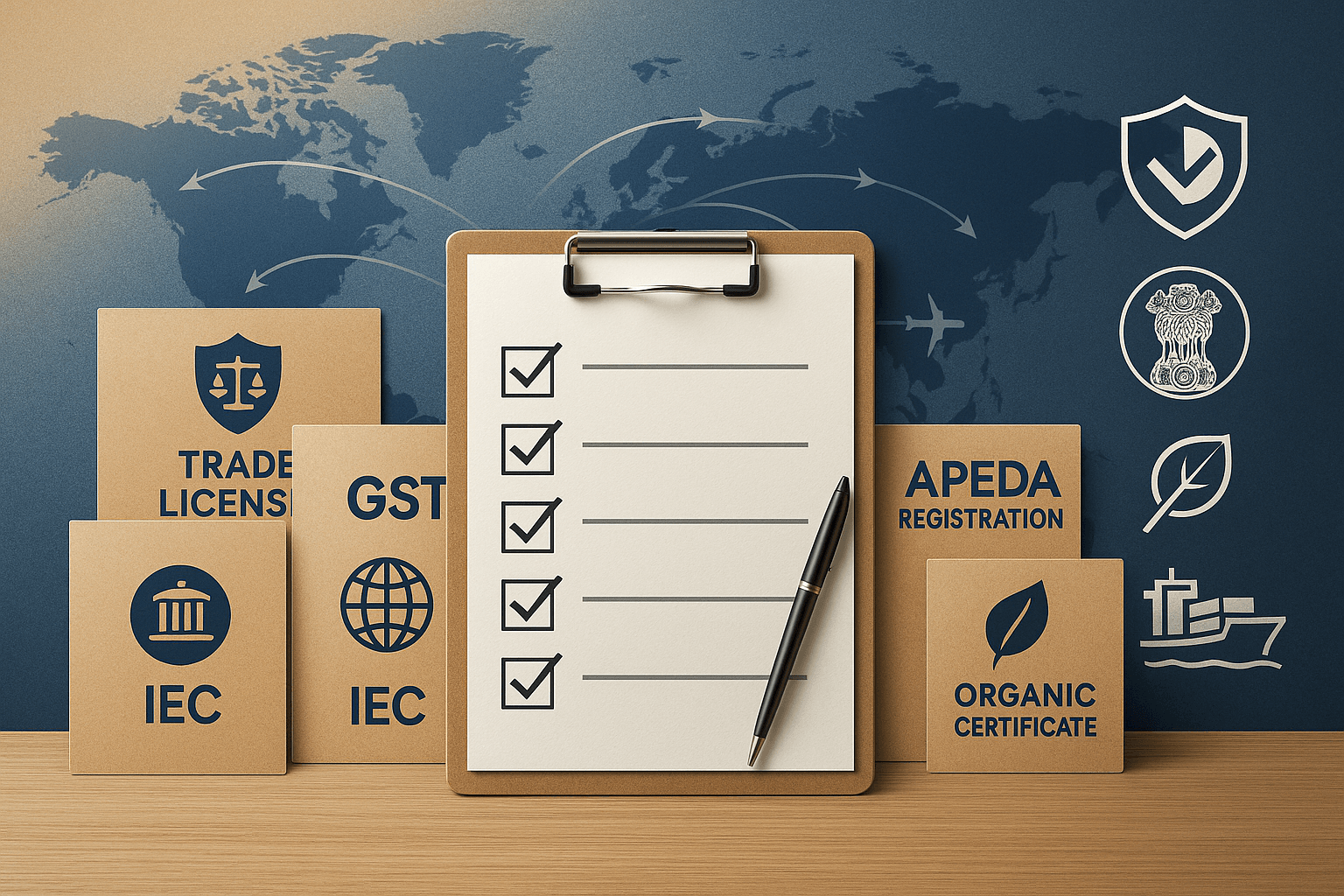
A complete verification checklist for importers of spices, food products & agro commodities
Introduction
As global demand for Indian spices, herbs, and agro products reaches record highs, more international buyers are looking toward India for reliable sourcing partners. But with increased opportunity also comes increased risk. Not every exporter advertising online is registered, certified, or compliant with Indian and international export regulations.
Choosing the wrong exporter can lead to financial loss, product quality issues, shipment delays, or even legal complications.
This guide—created by Spice of Indian, a certified Kerala-based exporter of premium spices—explains exactly how international buyers can verify a genuine Indian exporter before placing any order.
Whether you’re a wholesaler, distributor, private label brand, or retailer, this checklist ensures you only work with legitimate, legally compliant, quality-certified exporters.
1. Verify the Exporter’s Legal Business Registration
A trustworthy exporter will always have valid government registrations.
a. Trade License / Company Registration
Legitimate company types include:
- Private Limited Company (Pvt Ltd)
- Limited Liability Partnership (LLP)
- One Person Company (OPC)
- Sole Proprietorship
Ask for:
- Certificate of Incorporation
- PAN (Permanent Account Number)
- Registered office address
You can confirm registration on India’s MCA (Ministry of Corporate Affairs) website.
2. GST Registration (Goods & Services Tax)
GST is mandatory for all genuine Indian businesses—export or domestic.
A valid GST certificate ensures:
- Transparency in business
- Government-recognized operations
- Proper invoicing system
Buyers can verify GST numbers using the official GST portal.
If an exporter cannot provide GST details, it’s a major red flag.
3. Importer Exporter Code (IEC): Mandatory for All Exporters
The IEC is THE most critical license issued by DGFT (Directorate General of Foreign Trade).
Without an IEC, no company in India can legally export.
Ask for the exporter’s:
- IEC number
- IEC certificate (PDF)
You can verify IEC authenticity directly on the DGFT website.
If an exporter does not have IEC → Do not proceed.
4. APEDA Registration – Essential for Food & Agro Exporters
For grains, spices, rice, fruits, vegetables, and processed foods, the exporter MUST be registered with:
APEDA (Agricultural & Processed Food Products Export Development Authority)
APEDA ensures:
- Exporter credibility
- Quality norms compliance
- Hygienic processing & packing
- Government-recognized sourcing
APEDA also conducts training, inspections, and quality audits.
Tip: Genuine exporters will immediately share their APEDA Registration Number.
5. Spices Board India Registration (For Spice Exporters)
If you’re importing:
- Cardamom
- Black Pepper
- Cloves
- Turmeric
- Cinnamon
- Spice mixes
The exporter must be registered with Spices Board India.
This ensures:
- Export quality standards
- Regular product testing
- Validity of processing facilities
- Authenticity of spice origin
Always request the Spice Board CRES Certificate.
6. Organic Certifications (For Organic Buyers)
If you are importing organic spices or organic agro products, the exporter must have:
a. NOP (USDA Organic)
b. EU Organic Certification
c. NPOP / India Organic Certification
Ask for:
- Operator certificate
- Validity dates
- Certifying agency name
- Traceability documents
A genuine organic exporter will also provide:
- Field maps
- Farmer group details
- Internal Control System (ICS) documentation
7. Quality Assurance Documents (Must-Have Before Shipment)
A trustworthy exporter will always provide lab-tested documents such as:
• COA – Certificate of Analysis
• Microbial Test Report
• Pesticide Residue Report
• Moisture Content Report
• Heavy Metal Analysis
• Active Ingredient Content
(e.g., Curcumin % in Turmeric, Piperine % in Black Pepper)
These can be performed by:
- NABL-certified labs
- Private accredited labs
- Spices Board labs
Never accept products without proper testing—especially if you are exporting to Europe or the US.
8. Factory Audits & Physical Verification
Before finalizing a long-term agreement, request:
a. Virtual Factory Tour
A genuine exporter will gladly show:
- Cleaning & sorting facility
- Packaging area
- Storage conditions
- Machinery and hygiene standards
b. Third-Party Audit
You may request inspection from an external agency for large-volume shipments.
c. Visit the Facility
If possible, visiting the processing unit gives you 100% clarity on their credibility.
9. Essential Export Documentation Every Genuine Exporter Provides
Before shipping, the exporter must issue:
Pre-shipment Documents:
- Proforma Invoice
- Packing List
- FSSAI License
- APEDA/Spices Board registration proof
- COA (Certificate of Analysis)
- Phytosanitary Certificate
- Certificate of Origin
Post-shipment Documents:
- Commercial invoice
- Bill of Lading (Sea) or Airway Bill (Air)
- Insurance (if CIF)
- Export declaration
If an exporter hesitates to provide these → walk away immediately.
10. Red Flags – How to Spot a Fake or Non-Compliant Exporter
Be cautious of exporters who:
❌ Offer prices far below market rate
❌ Have no GST or IEC number
❌ Refuse video or factory inspection
❌ Cannot provide lab reports
❌ Provide fake or unverifiable certificates
❌ Communicate only through WhatsApp, with no official email
❌ Do not have a registered business address
❌ Ask for full payment without documentation
A genuine exporter prioritizes trust, traceability, and quality compliance.
11. Why Importers Trust Spice of Indian
At Spice of Indian, we follow a 100% transparent and compliant export process.
✔ Government-Registered Exporter
GST, IEC, Trade License, APEDA-approved.
✔ Certified Spice Exporter
Registered with Spices Board India.
✔ Organic-Compliant
Supporting NOP/NPOP organic standards.
✔ Laboratory Tested
Every batch undergoes microbial, pesticide, and quality testing.
✔ Kerala-Origin Sourcing
Premium spices grown naturally in the Western Ghats.
✔ End-to-End Export Support
Documentation, compliance, packaging, and logistics support.
For buyers who value purity, consistency, and professional export standards, Spice of Indian is a reliable long-term partner.
12. Buyer’s Quick Checklist (Save This!)
Before placing any order with an Indian exporter, verify:
✅ Registered company
✅ GST certificate
✅ IEC certificate
✅ APEDA / Spices Board registration
✅ Organic certificates (if applicable)
✅ COA & lab reports
✅ Factory audit (virtual or physical)
✅ Authentic business address
✅ Reasonable pricing
✅ Clear communication
✅ Complete documentation
If even one item is missing, reconsider the supplier.
Conclusion
Verifying a genuine exporter is not complicated—if you know what to look for.
By checking licenses, certifications, lab reports, audits, and documentation, you can confidently choose a trustworthy Indian supplier.
As a compliant, transparent, and quality-first exporter, Spice of Indian welcomes serious importers who value integrity and premium-grade products.
📩 For Samples, Quotations & Bulk Orders:
Contact Spice of Indian – Your Trusted Source for Authentic Indian Spices & Agro Products.
[…] and TradeIndia — connect with Indian exporters‘ […]