
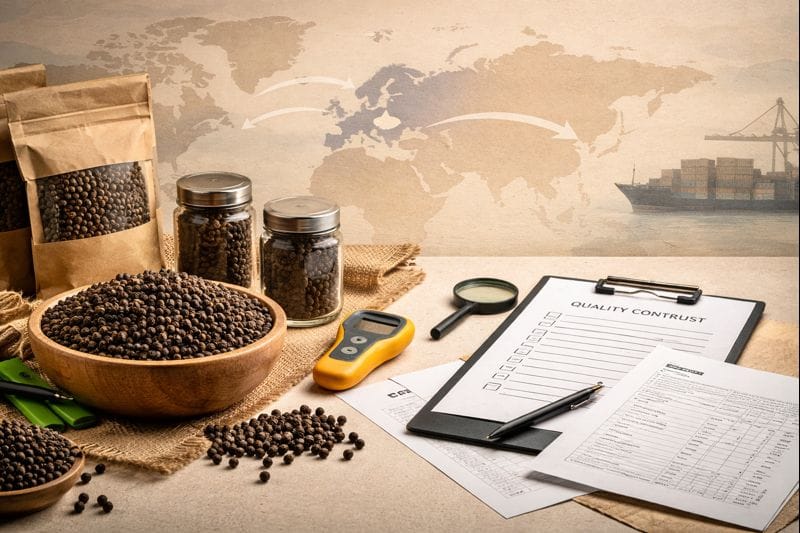
Leran how to export black pepper to Europe, an expert, compliance-focused export guide for EU markets by Spice of Indian
Europe is one of the largest and most regulated spice markets in the world, importing thousands of tonnes of black pepper every year for food processing, retail, pharmaceuticals, and HoReCa industries. As global buyers increasingly focus on food safety, traceability, and compliance, exporting black pepper to Europe has become both a high-value opportunity and a technical challenge.
India—particularly Kerala-origin black pepper—is globally respected for its high piperine content, strong aroma, and bold density. However, Europe’s strict regulations around pesticide residues, contaminants, microbial load, and traceability mean that only well-prepared exporters can succeed.
This article provides a complete, step-by-step guide on how to export black pepper to Europe, covering regulations, certifications, quality parameters, documentation, logistics, pricing logic, and buyer expectations. It is designed for Indian exporters, spice companies, traders, and agribusiness owners who want to enter or scale in the European market.
1. Introduction: Why Europe Is a High-Value Market for Indian Black Pepper
Black pepper, often referred to as the “King of Spices,” is one of the most traded spices globally. Europe is among the largest and most regulated import markets for black pepper, driven by consistent demand from:
- Food manufacturers
- Retail spice brands
- Meat & ready-meal processors
- Seasoning & oleoresin industries
India, especially Kerala, Karnataka, and Tamil Nadu, is globally respected for producing high-piperine, aromatic black pepper. However, exporting black pepper to Europe is not just about quality—it is about compliance, traceability, documentation, and strict food safety standards.
European Union (EU) regulations are among the toughest in the world, particularly regarding:
- Pesticide residues (MRLs)
- Aflatoxins
- Microbial contamination
- Steam sterilization & ETO-free processing
- Traceability from farm to shipment
This guide provides a step-by-step, practical roadmap for Indian exporters looking to enter or scale in the European black pepper market, covering certifications, quality grades, lab tests, logistics, documentation, pricing logic, and buyer expectations.
2. Understanding European Market Requirements for Black Pepper
Before exporting, it is critical to understand how Europe evaluates black pepper.
Key European Import Characteristics
- Preference for clean, residue-compliant pepper
- High demand for 600–630 GL density
- Strict adherence to EU pesticide MRLs
- Mandatory steam sterilization
- Preference for traceable, origin-specific pepper
- Strong focus on food safety documentation
Top Black Pepper Importing Countries in Europe
- Germany
- Netherlands
- France
- Italy
- Spain
- Belgium
- Poland
- UK (post-Brexit with EU-like standards)
Germany and the Netherlands act as distribution hubs for the rest of Europe.
3. Step-by-Step Guide: How to Export Black Pepper to Europe
STEP 1: Select the Right Export-Grade Black Pepper
European buyers do not accept all grades of pepper.
Preferred Indian Origins
- Kerala (Malabar, Tellicherry)
- Karnataka (Coorg pepper)
- Tamil Nadu (limited volumes)
Preferred Pepper Grades
| Parameter | EU Preferred Standard |
|---|---|
| Density | 600–630 GL |
| Piperine | 7–10% |
| Moisture | Max 12% |
| Extraneous Matter | <1% |
| Aflatoxin | Within EU limits |
| Color | Uniform black |
| Maturity | Fully mature berries |
Popular Export Grades
- MG1 (Malabar Garbled 1)
- TGEB (Tellicherry Garbled Extra Bold)
- ASTA-grade pepper
Low-density or FAQ grades are typically rejected for EU retail.
STEP 2: Mandatory Registrations & Certifications in India
To legally export black pepper to Europe, Indian exporters must hold the following:
1. IEC (Importer Exporter Code)
Issued by DGFT – mandatory.
2. GST Registration
Required even though exports are zero-rated.
3. APEDA Registration
Mandatory for agricultural exports.
4. Spices Board of India Registration
Critical for:
- Export approval
- Sampling & inspection
- Lab testing support
5. FSSAI License
Mandatory for food safety compliance.
Highly Recommended Certifications
- ISO 22000 / HACCP
- Organic certification (if applicable)
- EU-compliant processing unit approval
STEP 3: Understand EU Food Safety & Compliance Standards
Europe follows Regulation (EC) No 396/2005 and Regulation (EU) 2023/915 for contaminants.
Key Compliance Areas
1. Pesticide Residue Limits (MRLs)
EU MRLs are much lower than Indian domestic limits.
Commonly monitored pesticides:
- Chlorpyrifos (often zero tolerance)
- Carbendazim
- Imidacloprid
- Tricyclazole
Any violation leads to:
- Shipment rejection
- RASFF alert
- Importer blacklisting
2. Aflatoxin Limits
EU sets strict limits for:
- Aflatoxin B1
- Total aflatoxins
High moisture or poor storage increases risk.
3. Microbial Standards
- Salmonella: Absent
- Yeast & Mold: Controlled limits
- Total Plate Count (TPC): Within EU norms
STEP 4: Cleaning, Grading & Steam Sterilization
Cleaning & Grading
Export-grade pepper must pass through:
- De-stoning
- Gravity separation
- Color sorting
- Metal detection
Steam Sterilization
Europe strongly prefers:
- ETO-free pepper
- Steam-sterilized batches
Steam sterilization:
- Reduces microbial load
- Maintains aroma better than chemical treatment
- Is accepted by EU food authorities
STEP 5: Laboratory Testing (Non-Negotiable for Europe)
Before shipment, buyers will demand:
Mandatory Lab Reports
- Certificate of Analysis (COA)
- Pesticide residue test (EU MRL)
- Aflatoxin test
- Microbial analysis
- Moisture report
- GL density report
- Piperine content test
Testing must be done in:
- NABL-accredited labs
- Spices Board-approved labs
- EU-recognized labs (preferred)
STEP 6: Packaging & Labeling for EU Markets
Bulk Packaging
- 25 kg / 50 kg food-grade PP bags
- Poly-lined or vacuum-lined
- Palletized loads
Retail / Private Label (if applicable)
- Glass jars / PET containers
- EU-compliant labels
- Batch number & traceability code
- Country of origin clearly mentioned
Labeling Requirements
- Product name
- Botanical name (Piper nigrum)
- Net weight
- Country of origin
- Lot / batch number
STEP 7: Export Documentation for Europe
A complete export file includes:
Commercial Documents
- Proforma Invoice
- Commercial Invoice
- Packing List
Regulatory Documents
- Phytosanitary Certificate
- Certificate of Origin
- FSSAI License copy
- Spices Board registration
- APEDA registration
Quality Documents
- COA
- MRL report
- Aflatoxin report
- Sterilization certificate
Shipping Documents
- Bill of Lading
- Insurance (if CIF)
Incomplete documentation is a common reason for customs delays.
STEP 8: Logistics & Shipping to Europe
Preferred Shipping Mode
- Sea freight (20 ft / 40 ft containers)
Transit Time
- India → Europe: 25–35 days
Best Ports in India
- Cochin
- Tuticorin
- Nhava Sheva
- Chennai
Key EU Ports
- Rotterdam (Netherlands)
- Hamburg (Germany)
- Antwerp (Belgium)
STEP 9: Pricing Logic for Black Pepper Exports to Europe
European buyers price pepper based on:
- GL density (600 vs 630 GL)
- Piperine %
- Sterilization cost
- Organic vs conventional
- Lab testing & compliance cost
- Freight & insurance
- Contract volume
Market Insight
- 630 GL pepper may command 10–20% premium
- Organic pepper can be 25–50% higher priced
- Non-compliant pepper is unsellable in EU
STEP 10: Finding Buyers in Europe
Where Buyers Source
- Direct importers
- Spice processors
- Private label brands
- Ingredient distributors
How to Reach Them
- Trade fairs (Anuga, SIAL, BioFach)
- B2B platforms
- Embassy trade desks
- LinkedIn outreach
- Referrals via Spices Board
11. Common Mistakes Indian Exporters Must Avoid
- Ignoring EU MRL standards
- Shipping without full lab tests
- Using ETO sterilization
- Poor storage causing aflatoxin
- Over-promising quality
- Incomplete documentation
12. Why European Buyers Prefer Trusted Exporters Like Spice of Indian
At Spice of Indian, we follow a Europe-first compliance approach:
- Kerala-origin high-density pepper
- EU-compliant pesticide management
- Steam sterilized, ETO-free
- Full lab testing & documentation
- Transparent traceability
- Reliable logistics support
13. Conclusion
Exporting black pepper to Europe is highly profitable—but only for exporters who understand EU compliance, quality grading, and documentation.
India has the raw material advantage. Success depends on discipline, testing, transparency, and trust.
📩 For EU-compliant black pepper specifications, COA, samples, or bulk quotations, contact Spice of Indian.
Your reliable partner for premium Indian black pepper exports.
Frequently Asked Questions
1. What quality grade of black pepper is accepted in Europe?
European buyers typically require ASTA-clean black pepper with low pesticide residue, moisture below 12%, and high GL density (550–630 GL). Compliance with EU MRLs is mandatory.
2. What is the maximum moisture limit for black pepper exported to the EU?
The accepted moisture level for black pepper in the EU is maximum 12%. Lower moisture improves shelf life and reduces mold and aflatoxin risk.
3. Is steam sterilization mandatory for black pepper exports to Europe?
Steam sterilization is strongly recommended (and often demanded) by EU importers to meet microbial limits. ETO sterilization is largely rejected in Europe.
4. What documents are required to export black pepper from India to Europe?
Key documents include:
1) Certificate of Analysis (COA)
2) EU-compliant pesticide residue report
3) Phytosanitary Certificate
4) Certificate of Origin
5) Commercial Invoice & Packing List
6) Bill of Lading
5. What GL density is preferred by European buyers for black pepper?
Most EU buyers prefer 550 GL to 630 GL black pepper. Higher GL density indicates better maturity, higher piperine content, and stronger flavor.
6. What are the major European countries importing black pepper from India?
Top importing countries include Germany, Netherlands, Italy, Spain, France, Poland, and the UK, with Rotterdam and Hamburg acting as major entry ports.
7. How can EU buyers verify if an Indian black pepper exporter is genuine?
EU buyers should verify:
1) IEC & GST registration
2) Spices Board India registration
3) Lab reports from accredited labs (SGS/Bureau Veritas)
4) Physical packhouse audits or virtual inspections
8. What packaging is preferred for black pepper exports to Europe?
Standard packaging includes:
1) 25 kg PP bags with food-grade liner
2) Vacuum packing for premium grades
3) Palletized loads compliant with EU logistics norms
9. How long does it take to ship black pepper from India to Europe?
Typical transit time is:
1) Sea freight: 20–30 days
2) Air freight: 3–5 days (used for urgent or premium shipments)
10. Can Spice of Indian supply EU-compliant black pepper?
Yes. Spice of Indian supplies Kerala-origin black pepper with:
1) EU MRL compliance
2) Steam sterilization
3) Accredited lab testing
4) Export-ready documentation
This step-by-step guide on how to export black pepper to Europe is invaluable for Indian exporters aiming to expand globally. Clear, practical, and profit-focused insights!