
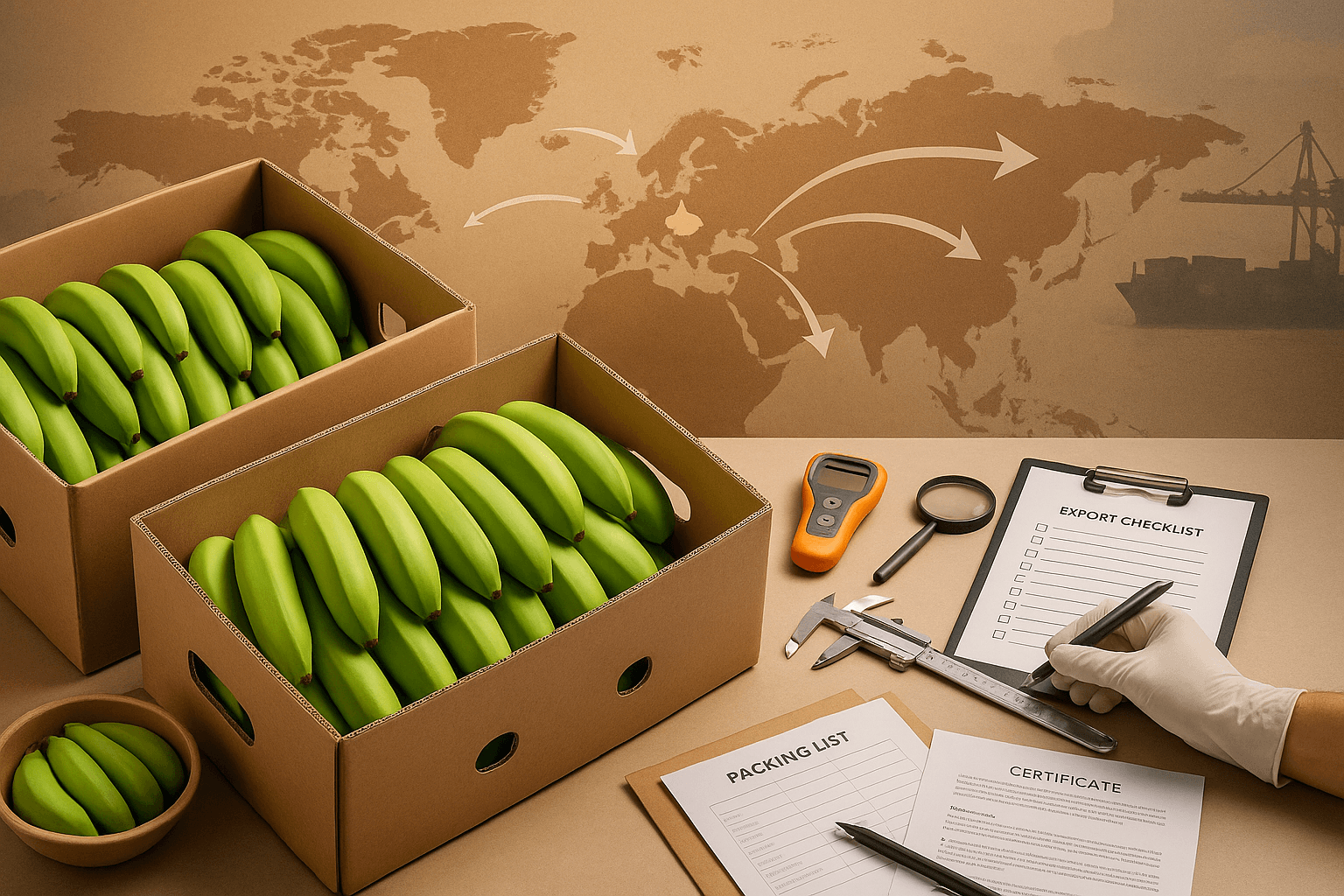
1. Introduction
Bananas are the world’s most consumed fruit and one of the most traded tropical commodities globally. With rising demand in the Middle East, Europe, and South Asia, banana exports have emerged as a massive opportunity for Indian agribusinesses, farmers, and trading companies.
India ranks as the largest producer of bananas in the world, contributing nearly 25% of global production. Major banana-growing states like Tamil Nadu, Maharashtra, Andhra Pradesh, Gujarat, and Karnataka are home to advanced farming systems, contract farming networks, and APEDA-backed export clusters.
Although India produces more bananas than any other country, it historically exported very little compared to Latin American exporters. But this has changed dramatically in the last decade.
Why Banana Export is Becoming a Highly Profitable Sector for India
- Rising demand for Cavendish bananas in the GCC, Central Asia, Europe, and East Asia
- Improved packhouses with pre-cooling and ripening control
- Better post-harvest handling practices
- Reefer container accessibility at all major ports
- APEDA’s efforts on training & quality compliance
- Superior shelf-life after Indian exporters adopted global standards
Today, India is not only meeting domestic consumption but is also fast becoming a competitive global exporter.
Whether you are a beginner exporter, trader, agribusiness entrepreneur, or banana-farming company, understanding the export process, documentation, quality standards, packaging norms, and buyer expectations is crucial.
This blog provides the most detailed, step-by-step guide for exporting bananas from India — along with the list of top importing countries and practical insights for building a sustainable banana export business.
2. Types of Bananas Commonly Exported from India
India grows over 20 varieties of bananas, but only a few are preferred in international markets due to shelf-life, visual appeal, firmness, and transit stability.
1. Cavendish Banana (Most Exported Variety Worldwide)
- Preferred by GCC, Europe, Russia, and South Asia
- Long shelf-life
- Thick peel for transportation stability
- Uniform size & color
Most Indian exporters focus on Cavendish
2. Robusta Banana
- Popular in Middle East & East Africa
- Strong aroma
- Suitable for local supermarkets and wholesale markets
3. Red Banana (Specialty Export Product)
- Premium pricing
- Nutrient-rich, attractive appearance
- Export niche markets: UAE, Oman, Singapore
4. Nendran / Plantain (Kerala Variety)
- Used for chips, flour, and cooking
- Big demand in Malaysia, Sri Lanka, and Gulf markets
5. Yelakki / Elaichi Banana
- Smaller in size but highly aromatic
- Popular in Maldives, Singapore, and Qatar
Each variety has specific grade standards, packaging requirements, and transit handling needs — making variety selection one of the most important early steps in banana export business.
3. Step-by-Step Guide: How to Export Bananas from India
This is the core of the blog — a complete, professional-level breakdown of the export process.
STEP 1: Understand Market Requirements & Quality Standards
Each importing country has its own standards for:
- Fruit maturity index
- Length & diameter
- Color stage (Green Stage 1–2 preferred)
- Residue limits (MRL compliance)
- Permitted pesticides for cultivation
- Packaging requirements
- Banana crown cutting standards
- Temperature requirements
General Export Quality Standards
- Banana size: 18–25 cm
- Weight: 180–220g per piece
- Hand weight: 1.2–1.5kg
- No major scars or latex stains
- No black spots or fungal infections
- Firm texture, unripe, Stage 1 (deep green)
Pesticide & MRL Requirements
Export bananas must comply with limits for:
- Carbendazim
- Thiabendazole
- Imidacloprid
- Chlorpyrifos
(This varies by country; EU is the strictest.)
Certifications That Improve Export Credibility
- Global GAP (highly recommended for European markets)
- APEDA Registration (mandatory for agricultural exports from India)
- FSSAI License
- Packhouse Certification
Understanding these quality parameters is crucial for securing long-term buyer contracts.
STEP 2: Register Your Banana Export Business in India
To export bananas legally from India, you need the following registrations:
1. IEC Code (Importer Exporter Code)
Issued by DGFT — mandatory for all exporters.
2. GST Registration
Even though exports are zero-rated, GST number is required.
3. APEDA Registration
APEDA supports exporters with:
- Approved packhouses
- Export subsidies
- Training and market intelligence
4. Register Your Packhouse
Banana exports must be handled in APEDA-certified packhouses with:
- Sorting line
- Washing system
- Crown cutting facility
- Pre-cooling chamber
- Cold storage
- Ripening control systems
Optional but recommended:
- Startup India Registration
- ISO or HACCP Certification
These increase buyer confidence and improve your ability to compete globally.
STEP 3: Sourcing Bananas & Post-Harvest Handling
Major Banana Sourcing Regions for Export
- Maharashtra: Jalgaon, Solapur
- Tamil Nadu: Trichy, Theni
- Andhra Pradesh: Kurnool, Vijayawada
- Gujarat: Bharuch, Navsari
Working directly with farmers or FPOs (Farmer Producer Organizations) ensures:
- Better pricing
- Better quality control
- Consistent supply
✔ Post-Harvest Handling Steps
1. Harvesting
- Harvest at 75–80% maturity
- Deep green color
- Early morning or late afternoon harvesting
2. De-Sapping
Immediately after harvesting:
- Remove latex
- Clean the stalk
- Prevent staining
3. Washing & Disinfection
Bananas are washed in:
- Chlorinated water
- Anti-fungal solutions
4. Grading & Sorting
Sorting by:
- Size
- Weight
- Color uniformity
5. Pre-Cooling
Temperature reduced to:
- 13–14°C
Slows down ripening during transit.
STEP 4: Packaging & Labeling for Banana Export
Banana is one of the most sensitive perishable exports, and correct packaging ensures that fruit arrives fresh, firm, and undamaged.
✔ Packaging Standards for Export Bananas
Typical export cartons are:
- 13 kg, 14 kg, 15 kg, 18 kg corrugated boxes
- 5-ply or 7-ply corrugated cardboard
- Ventilation holes for air circulation
- High burst strength
Box Features:
- Strong bottom support
- Ventilation on all sides
- Outer waterproof lamination (optional)
- Food-grade inner liner (HDPE)
- Banana-holding cavities or padding
🔶 Banana Packing Configurations
- Single-layer or double-layer boxes
- Cluster packaging, separated to ensure minimal rubbing
- Hands arranged with crown up for stability
- Plastic film liners to maintain humidity
🔷 Labeling Requirements
Most importing countries require:
- Exporter name & address
- Country of origin (“Product of India”)
- Net weight
- Banana variety (Cavendish / Robusta etc.)
- Packing date & batch number
- Temperature handling instructions
- Barcodes / QR codes
- Buyer branding (if private label)
Proper labeling reduces the risk of customs delays and product rejection.
STEP 5: Cold Chain Management & Logistics
Bananas must be transported in controlled temperature environments to arrive fresh. Cold chain management is the most critical factor in reducing post-harvest losses.
✔ Cold Chain Requirements
1. Pre-cooling
Immediately after packing:
- Reduce pulp temperature to 13–14°C
This significantly slows ripening and maintains firmness.
2. Transportation to Port
Refrigerated vehicles (reefers) maintain:
- 13°C
- 85–90% relative humidity
Bananas should not be exposed to outside air during loading/unloading.
3. Container Loading
Reefer Containers (40 ft HC)
- Temperature: 13–14°C
- Humidity: 85–95%
- Fresh air exchange: 25–30 m³/hr
- Ethylene control mechanisms to prevent premature ripening
Cavendish bananas must travel unripened to avoid spoilage.
4. Transit Time
Average transit times:
- UAE / Oman / Qatar → 4–7 days
- Saudi Arabia → 7–9 days
- Iran → 3–5 days (Chabahar)
- Turkey → 15–18 days
- Europe → 20–28 days
- Maldives → 3–4 days
Shorter transit times in GCC make them ideal markets for India.
STEP 6: Export Documentation for Banana Export
Bananas fall under perishable agricultural produce, so documentation plays a huge role in compliance and buyer approval.
Below are documents required from India:
📌 Core Export Documents
1. Commercial Invoice
Sales document containing price, terms, and product details.
2. Packing List
Weight, dimensions, number of boxes, batch numbers.
3. Bill of Lading (Sea) / Airway Bill (Air)
Transport document issued by the shipping line or airline.
📌 Mandatory Agricultural Export Documents
4. Phytosanitary Certificate
Issued by Plant Quarantine (P&Q) Department of India
Confirms:
- Fruit is pest-free
- Meets import country regulations
5. Certificate of Origin (CoO)
Issued by Chambers of Commerce / APEDA
Required for customs clearance.
📌 Quality & Compliance Certificates
6. Fumigation Certificate
Confirms treatment to eliminate insects.
7. Health Certificate
For GCC and European markets.
8. Residue/MRL Test Report
Confirms pesticide levels within permissible limits.
9. APEDA Registration Certificate
10. Insurance Certificate (Optional but recommended)
📌 Optional but Buyer-Preferred Documents
- Lab test reports
- GAP certification (Global GAP)
- HACCP, ISO 22000 certificates
Having complete documentation builds trust and prevents shipment delays.
STEP 7: Finding Buyers & Expanding Your Export Network
Finding reliable buyers is the backbone of a successful banana export business.
✔ Where to Find Buyers
1. B2B Websites
- Alibaba
- TradeIndia
- GlobalTrade
- Indiamart International
- ExportersIndia
- EC21
2. International Trade Fairs
- Gulfood (Dubai)
- Fruit Logistica (Berlin)
- Foodex Japan
- Saudi Food Show
- Asia Fruit Congress
These exhibitions feature thousands of supermarket chains, importers, and distributors.
3. Direct Market Research
Target:
- Hypermarkets
- Wholesale fruit markets
- Retail chains
- Food distributors
- Hotel suppliers
✔ Key Buyer Profiles
- Importers for supermarkets
- Ripening center operators
- Banana distributors
- Private label fruit brands
- Hotels & hospitality suppliers
✔ Building Long-Term Buyer Relationships
- Ensure consistent quality
- Maintain transparency
- Share weekly production updates
- Offer private label options
- Provide documentation promptly
Buyers prefer exporters who are responsive, reliable, and consistent.
Top Banana Importing Countries for Indian Exporters
India exports bananas primarily to the Middle East, South Asia, Central Asia, and parts of Europe.
Here are the top markets:
🌍 1. United Arab Emirates (UAE)
- India’s largest market
- Short transit time (4–5 days)
- High demand for Cavendish
- Supermarkets: Carrefour, Lulu Hypermarket
🌍 2. Saudi Arabia
- One of the strongest buyers
- Prefers premium size & appearance
- Growing demand due to population growth
🌍 3. Oman
- Great for medium-sized exporters
- Regular weekly shipments
🌍 4. Qatar
- Buyers look for high-quality packaging
- Stable demand
🌍 5. Iran
- Huge demand; direct shipping via Chabahar Port
- Fast-growing market
🌍 6. Turkey
- Imports Cavendish for distribution & ripening centers
🌍 7. Maldives
- Very high dependence on Indian fruit exports
- Small but premium market
🌍 8. Bangladesh & Nepal
- Overland shipments
- Low-cost logistics
🌍 9. Europe (Netherlands, Germany, UK)
- Very high standards
- Requires Global GAP + strict pesticide compliance
India is now entering European markets more aggressively with APEDA-backed initiatives.
🌍 10. Russia & CIS Countries
- Stable demand
- Exporters need strong logistics partners
7. Major Challenges in Banana Export & How to Overcome Them
While banana exports offer high profit potential, exporters must manage several operational and compliance challenges. Understanding these issues upfront and building the right systems can make your export business far more efficient and reliable.
Challenge 1: Short Shelf Life & Ripening Risk During Transit
Bananas continue to breathe after harvest, releasing ethylene gas, which accelerates ripening. In hot climates and long sea journeys (12–18 days), bananas can ripen prematurely and spoil.
Solution
- Always maintain 13–14°C temperature in reefer containers
- Use APEDA-approved pre-cooling chambers
- Choose fast shipping routes when possible
- Ship at Color Stage 1 (deep green)
- Use ethylene-absorbing pads
- Proper ventilation inside cartons
Good cold chain management is the single most important factor in successful banana export.
Challenge 2: Physical Damage During Handling
Bruising, abrasions, crown cuts, latex stains, and mechanical damage can lead to buyer rejection.
Solution
- Train farm workers in careful harvesting
- Use foam inserts inside cartons
- Avoid moisture on bananas during packing
- Ensure clean, sharp crown-cut tools
- Avoid dropping or throwing bunches
Export bananas require premium handling from field to reefer.
Challenge 3: Variation in Size & Color
Inconsistent size and color lead to lower prices and customer dissatisfaction.
Solution
- Grade bananas using a calibrated sorting line
- Maintain uniform maturity levels
- Cluster sourcing from single farms for consistency
Uniformity is essential for retail supermarket contracts.
Challenge 4: Quality Rejections Due to MRL & Fungal Issues
Many countries (especially Europe and Japan) reject bananas for:
- Excessive chemical residues
- Anthracnose
- Black spots
- Crown rot
Solution
- Use GAP-compliant farms
- Maintain proper fungicide spray intervals
- Test pesticide residue before shipment
- Maintain strict hygiene in packhouses
A good exporter has preventive systems, not corrective actions.
Challenge 5: Finding Genuine Buyers
Many exporters struggle with:
- Fake buyers
- Non-serious inquiries
- Price haggling
- Payment delays
Solution
- Use verified B2B platforms
- Ask for import history
- Request LOI (Letter of Intent) before final pricing
- Never ship without Advance + LC or Escrow arrangement
Professional buyers value transparent systems.
8. Why Indian Bananas Are Gaining Global Popularity
There are solid, data-driven reasons why global demand for Indian bananas is rising each year.
1. Competitive Pricing
India offers 10–25% lower cost than many Latin American suppliers.
2. Strong Agricultural Base
India’s production scale ensures consistent and large-volume supply.
3. Improved Logistics & Supply Chain
Better cold chain, reefer availability, and APEDA packhouses.
4. Higher Profitability for Retailers Abroad
Indian bananas provide excellent margins for supermarket chains due to:
- Attractive pricing
- Good shelf life
- Strong consumer acceptance
5. Growing Branding & Packaging Standards
Top exporters now offer:
- Branded corrugated boxes
- Custom printing
- Barcoding & retail-ready designs
Indian bananas are now competitive in both bulk wholesale and premium retail segments.
9. Buyer Expectations in International Markets
Different markets have different buyer requirements.
Middle East (UAE, Oman, Qatar, Kuwait, Bahrain)
- Want large size, bright green, high-weight bunches
- Prefer Cavendish
- Shorter transit → higher demand for Indian supply
Iran & Iraq
- Very high-volume markets
- Competitive pricing needed
Europe (Netherlands, Germany, UK)
- Strict MRL norms
- Require Global GAP certification
- Premium packaging needed
Maldives & Sri Lanka
- Prefer Elaichi (Yelakki) and Nendran varieties
Understanding market-specific needs improves your success rate significantly.
10. Export Profit Margin Overview
Banana export profitability depends on:
Costs:
- Farm procurement
- Packhouse processing
- Packaging
- Local transport
- Reefer container booking
- Clearing & forwarding
- Freight charges
Revenue:
- FOB price
- CIF price
- Market demand
Large-volume orders can give exporters 10–20% profit margins, especially in GCC markets.
11. Best Practices for Success in Banana Export
To thrive in the global banana export market:
✔ Build long-term contracts with farmers
✔ Invest in a certified packhouse
✔ Maintain strict cold chain
✔ Test for pesticide residue & quality
✔ Use strong packaging
✔ Build relationships with reliable shipping agents
✔ Provide buyers with consistent quality
Consistency is the ultimate competitive advantage.
12. Conclusion
Banana export is one of India’s fastest-growing agribusiness opportunities. With the right sourcing, packaging, documentation, and cold chain systems, exporters can build a profitable, long-term business supplying Cavendish, Robusta, Yelakki, Nendran, and plantains to global markets.
As global buyers—from supermarkets to wholesalers and distributors—look for stable, cost-effective, and high-shelf-life bananas, India is becoming a preferred sourcing hub.
By following the step-by-step guide above, exporters can ensure:
- Compliance with APEDA standards
- Strong relationships with buyers
- High-quality fruit delivery
- Sustainable growth and profitability
If you are ready to explore banana exporting, now is the perfect time.
📩 At Spice of Indian, we combine top-grade sourcing, strong supply chain partnerships, strict lab testing, and export professionalism to deliver the finest banana worldwide.
For detailed specifications, samples, or bulk quotations—contact Spice of Indian today.
Your reliable partner for premium Indian ingredients.