The Buyer Who Asked Why We Were More Expensive
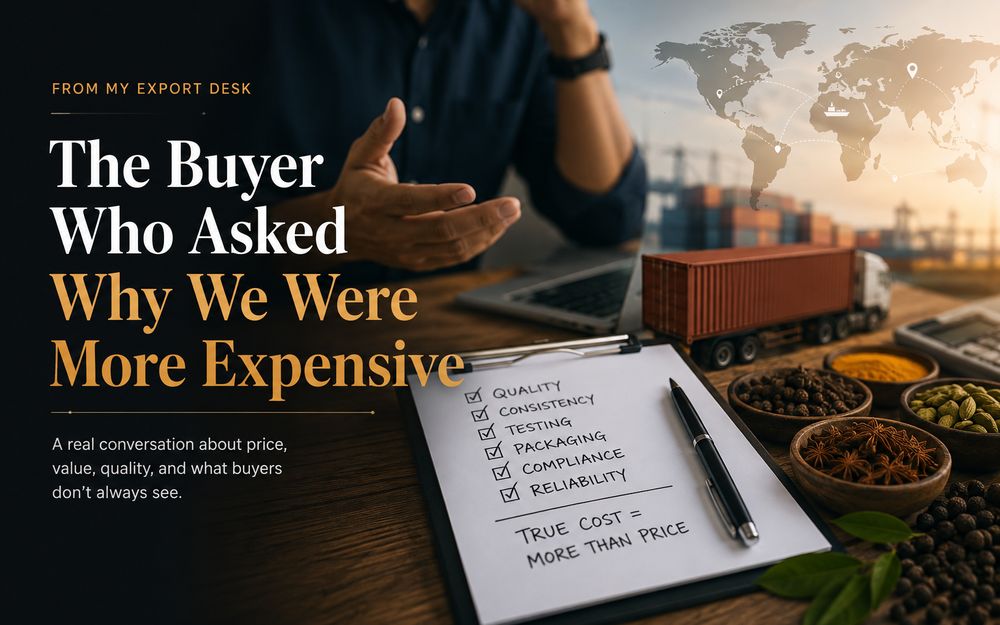
It was a Tuesday morning in February when the email came in. Subject line: "Re: Cumin Seed Quotation — Please Clarify Pricing."
I still remember opening it standing at my desk in Kochi, coffee in hand, expecting the usual back-and-forth on quantity and shipment terms. Instead, it was four lines, and the tone was polite but unmistakably direct.
"We have three quotations for 99% pure cumin seeds, machine cleaned, sortex grade. Yours is nearly 12% higher than the other two. Can you explain why we should pay more for the same product?"
It was signed by a procurement manager at a mid-sized spice trading and food-processing company in Germany. I'll call him Markus, because that's close enough to who he is and this story isn't really about him — it's about a question every exporter eventually has to answer honestly, in writing, to someone who is not obligated to believe you.
Why This Question Comes Up in Every Cumin Export Deal
If you've spent any time in the spice trade, you know cumin is one of the most commoditized products we handle. Unlike cardamom or saffron, where quality differences are visible to the eye, cumin from Gujarat and Rajasthan can look nearly identical from one lot to the next — same colour, same size, same smell in a quick sniff test. On paper, a buyer comparing quotations sees a product code, a price per metric ton, and not much else. So when three suppliers quote for "99% pure cumin seed" and the numbers don't match, the natural question is: what am I actually paying for?
I didn't take Markus's email as an insult. I took it as an opening. So instead of defending the price in the reply, I asked him to send me the other two quotations — specifications and all. He did, which told me something too: he wasn't just trying to beat us down, he genuinely wanted to understand what he was buying.
What the Other Quotations Didn't Say
The two competing offers were both for "sortex grade, 99% pure, moisture 8% max." Reasonable-sounding numbers. But neither quotation mentioned volatile oil content, which for cumin is the single biggest driver of actual flavour and market value — buyers using cumin in food manufacturing care about oil content between 2.5% and 4%, not just visual purity. Neither mentioned admixture percentage beyond the headline purity figure. Neither offered a pre-shipment Certificate of Analysis from an accredited lab. And neither supplier had listed a single food safety certification on their letterhead.
I wrote back to Markus with our specification sheet side by side with theirs, and for the first time in the conversation, I stopped talking about price and started talking about what the price was actually covering:
- ISO 22000 and HACCP-certified processing — not a claim, but a certified system covering how our cumin is cleaned, sortexed, and packed, with documentation available for his quality team to review before the container ever leaves India.
- APEDA registration and full traceability — meaning we could tell him which farmer cluster and which mandi the lot originated from, not just "sourced from Gujarat."
- Third-party lab testing on every shipment — aflatoxin, pesticide residue against EU MRLs, moisture, and volatile oil content, with the Certificate of Analysis issued before dispatch, not requested after a rejection at the port.
- A grading standard tighter than the trade minimum — our sortex line runs cumin through additional passes to hold admixture below 0.5%, well under the 1% that's typical in standard commercial grade.
None of this was marketing language. It was the actual bill of costs behind our number, itemized.
The Real Cost of "Cheaper" Cumin
Here's the part of the reply that I think actually moved the conversation forward. I didn't just explain our own certifications — I explained what happens on the other side when a buyer chooses the cheaper lot and it goes wrong.
I've watched it happen to importers before: a container held at the port of Hamburg or Rotterdam because pesticide residue testing flags a level above the EU's permitted limit, and now there's a demurrage bill running by the day, a shipment that can't be released, and sometimes a full re-export or destruction order. I've seen buyers get a "99% pure" lot that tests out fine on purity but is short on volatile oil, so their own food-manufacturing customers reject the batch on flavour strength. None of that shows up on a quotation. It only shows up after the money has already moved.
I told Markus plainly: our price includes the cost of him never having to have that conversation with his own customers. That's not a discount he was giving up — it's a risk he wasn't buying.
Reliability Is Also Part of the Price
There was one more thing I raised that had nothing to do with lab reports. I asked him how many of his current suppliers had ever missed a shipment window on him. He didn't answer directly, but the pause told me enough.
Consistent, on-time export isn't free. It means we hold safety stock through the sourcing season instead of buying hand-to-mouth against orders. It means we work with farmer clusters we've sourced from for years, not whoever quotes lowest that week. It means when a vessel schedule changes, we have the relationships at the port to rebook without three weeks of delay. That reliability is baked into our cost structure too, and it's usually invisible until the one time a buyer needs it and a cheaper supplier can't deliver.
What Happened Next
Markus didn't accept our price on that email. To his credit, he asked for a small trial order first — one container, our full grade, our documentation, our terms. Fair request. We shipped it exactly as specified, the Certificate of Analysis matched what we'd promised, and it cleared without a single query from his quality team.
The second order was a long-term contract. That was three years ago. Markus is still a customer today, and somewhere along the way he told me something I've held onto since:
"I don't mind paying more. I mind not knowing what I'm paying for."
The Lesson for Anyone Exporting Spices
I've had some version of that email more times than I can count since — sometimes about cumin, sometimes about pepper or cardamom, always some version of "why are you more expensive." My answer has gotten more precise over the years, but the substance hasn't changed. We don't compete on being the cheapest cumin seed exporter from India. We compete on being the exporter whose documentation, grading, and shipment record hold up to scrutiny, every single time, because that's what actually protects a buyer's business on the other end.
If you're an importer comparing spice quotations right now and the numbers don't line up, my honest advice is the same thing I told Markus: ask for the specification sheet behind the price, not just the price. The gap usually explains itself.
Have a question about sourcing this from India?
Request a Quote